
A Strategic Framework to Scale Velocity, Protect Brand Trust, and Drive Local SEO Dominance
In today’s local search ecosystem, Google Reviews are far more than public word-of-mouth testimonials. They serve as a foundational, algorithmic ranking engine that directly feeds Google's Prominence pillar—one of the three core factors determining whether your business appears in the coveted Google Maps Local Pack.
However, many local business owners handle customer feedback reactively—replying to reviews sporadically, asking for feedback in inconsistent bursts, or ignoring minor rating drops altogether.
To turn customer feedback into a scalable, high-converting growth engine, you need a structured management strategy. In this comprehensive guide, we will break down the essential best practices for managing your Google Reviews, optimizing review velocity, and staying 100% compliant with Google's evolving policy guidelines.
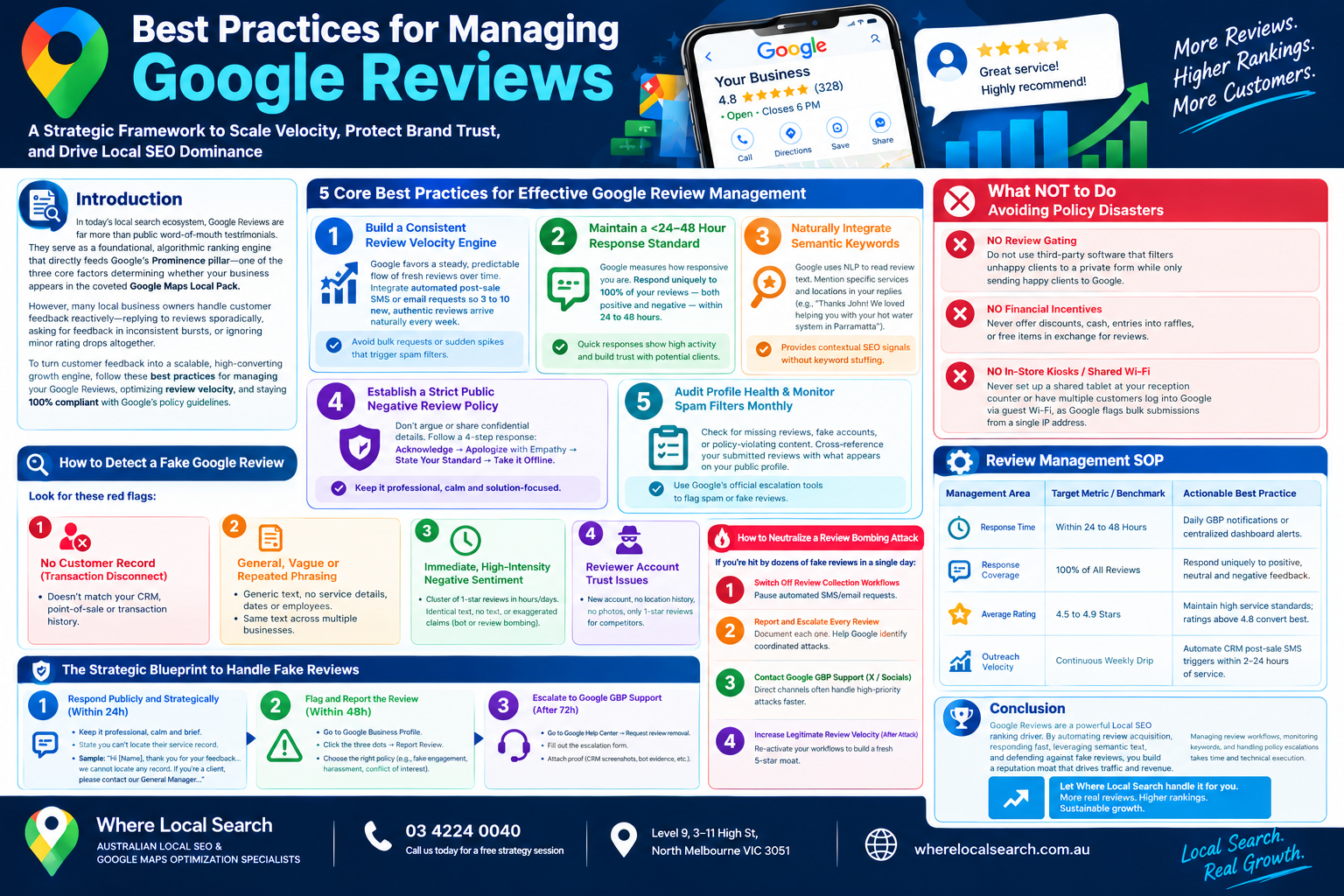
5 Core Best Practices for Effective Google Review Management
1. Build a Consistent Review Velocity Engine
Google’s algorithm heavily favors Review Velocity—the steady, predictable arrival of fresh customer feedback over time.
💡 The Best Practice: Avoid sending massive email blasts to thousands of clients once a year, as sudden spikes trigger Google's automated spam filters. Instead, integrate automated post-sale SMS or email review requests into your daily CRM workflow so that 3 to 10 fresh, authentic reviews arrive naturally every week.
2. Maintain a <24–48 Hour Response Standard
Google actively measures how responsive a business owner is across its platform.
💡 The Best Practice: Aim to respond uniquely to 100% of your reviews—both positive and negative—within 24 to 48 hours. Quick responses demonstrate high operational activity to search engines and signal to potential clients that your customer service doesn't end at the point of sale.
3. Naturally Integrate Semantic Keywords in Responses
Google utilizes Natural Language Processing (NLP) models to parse the text inside review threads.
💡 The Best Practice: When crafting personalized replies to happy customers, naturally reference the specific service provided and your operating location (e.g., "Thanks John! We loved helping you out with your hot water system installation here in Parramatta"). This provides contextual SEO signals without unnatural keyword stuffing.
4. Establish a Strict Public Negative Review Policy
Negative reviews are inevitable for a growing business, but how you handle them publicly dictates your conversion rates.
💡 The Best Practice: Never argue, get defensive, or discuss confidential details in public comments. Follow a strict 4-step crisis response: Acknowledge → Apologize with Empathy → State Your Operational Standard → Take the Conversation Offline Immediately.
5. Audit Profile Health & Monitor Spam Filters Monthly
Legitimate reviews sometimes get shadow-banned, while malicious competitors may drop fake reviews on your profile.
💡 The Best Practice: Conduct a monthly review audit. Cross-reference your submitted client reviews with what actually appears on your live public profile. Immediately flag spam, fake accounts, or policy-violating content using Google's official escalation tools.
What NOT to Do: Avoiding Policy Disasters
Violating Google's strict Review Guidelines can result in severe algorithmic penalties, total review purges, or instant account suspensions. Ensure your team avoids these critical traps:
Do not use third-party software that filters unhappy clients to a private feedback form while only sending happy clients to Google.
Never offer discounts, cash, entries into raffles, or free items in exchange for customer reviews.
Never set up a shared tablet at reception or have customers submit reviews over guest Wi-Fi, as bulk same-IP posts trigger fraud flags.
Review Management Standard Operating Procedure (SOP)
| Management Area | Target Metric / Benchmark | Actionable Best Practice |
|---|---|---|
| Response Time | Within 24 to 48 Hours | Set up daily GBP notifications or centralized dashboard alerts. |
| Response Coverage | 100% of All Reviews | Respond uniquely to positive, neutral, and negative feedback. |
| Average Rating | 4.5 to 4.9 Stars | Maintain high service standards; ratings above 4.8 convert best. |
| Outreach Velocity | Continuous Weekly Drip | Automate CRM post-sale SMS triggers within 2–24 hours of service. |
Conclusion
Mastering Google Review management is an essential pillar of long-term Local SEO success. By automating your review acquisition, enforcing fast response protocols, leveraging semantic text depth, and defending your listing against fake spam, you build a powerful reputation moat that continuously drives traffic to your business.
Integrating automated CRM triggers, crafting unique responses daily, monitoring keyword extractions, and navigating complex policy escalations takes consistent time and specialized technical execution.
If you want to streamline your review management workflows and dominate the Google Maps Local Pack across Australia, the team at Where Local Search is here to manage it all for you. As leading experts in Australian Local SEO and Google Maps optimization, we take care of the technical heavy lifting—turning customer feedback directly into sustainable commercial revenue.