
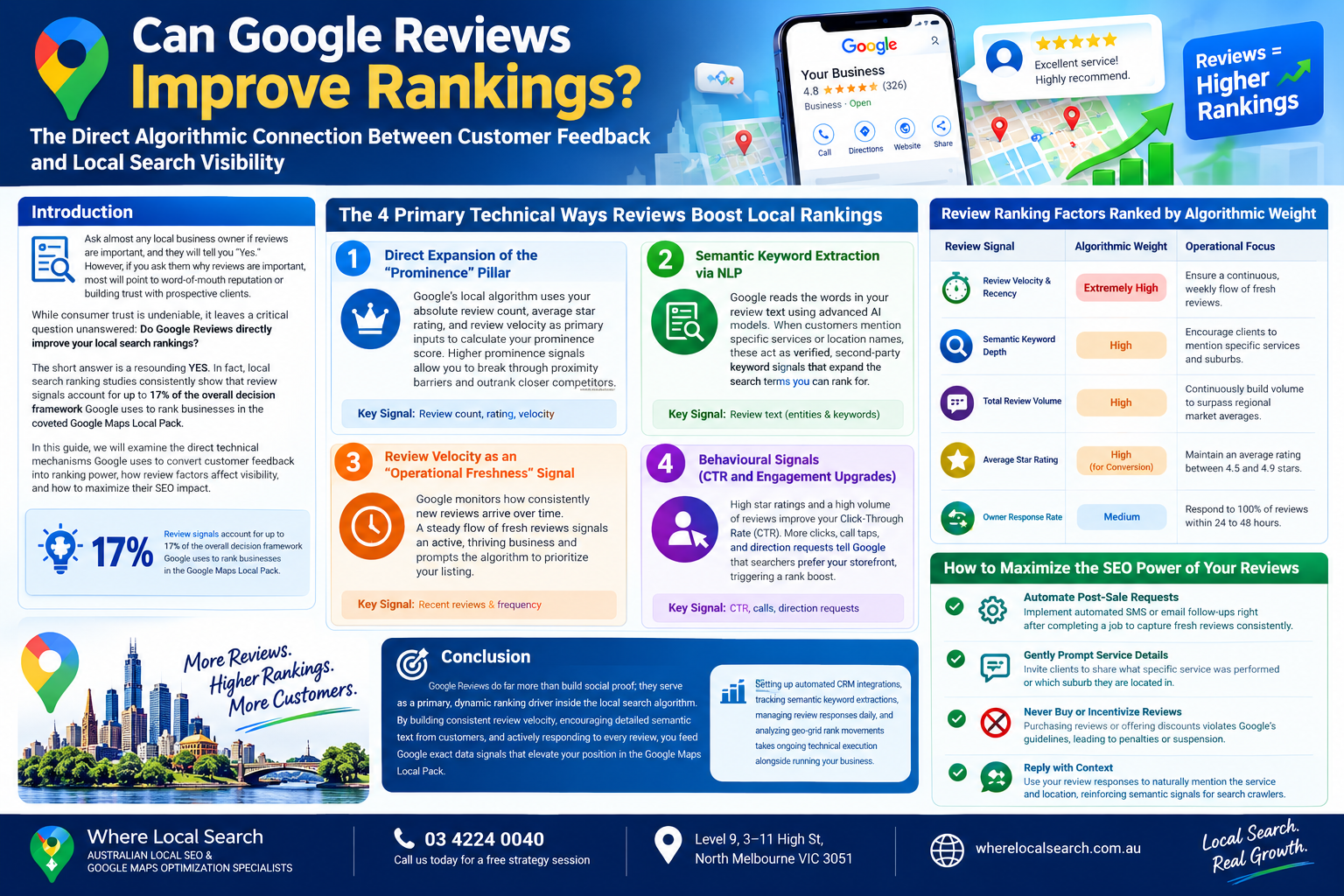
The Direct Algorithmic Connection Between Customer Feedback and Local Search Visibility
Ask almost any local business owner if reviews are important, and they will tell you “Yes." However, if you ask them why reviews are important, most will point to word-of-mouth reputation or building trust with prospective clients.
While consumer trust is undeniable, it leaves a critical question unanswered: Do Google Reviews directly improve your local search rankings?
The short answer is a resounding YES. In fact, local search ranking studies consistently show that review signals account for up to 17% of the overall decision framework Google uses to rank businesses in the coveted Google Maps Local Pack.
In this guide, we will examine the direct technical mechanisms Google uses to convert customer feedback into ranking power, how review factors affect visibility, and how to maximize their SEO impact.
The 4 Primary Technical Ways Reviews Boost Local Rankings
1. Direct Expansion of the "Prominence" Pillar
Google officially structures its local ranking algorithm around three pillars: Distance, Relevance, and Prominence.
💡 The Technical Connection: Prominence measures how authoritative, well-known, and trusted a business is compared to its peers. Google's algorithm uses your absolute review count, average star rating, and review velocity as primary inputs to calculate your prominence score. Higher prominence signals allow your profile to break through proximity barriers and outrank closer competitors.
2. Semantic Keyword Extraction via Natural Language Processing (NLP)
Google does not just count the number of stars on your profile; it actively reads the words left in the review text using advanced AI text parsing models.
💡 The Technical Connection: When customers naturally mention specific services or location names in their feedback (e.g., "Great experience with their emergency pipe repair in Richmond"), Google extracts those entities. These act as verified, second-party keyword signals that directly broaden the exact search terms your listing qualifies to rank for.
3. Review Velocity as an "Operational Freshness" Signal
A common mistake made by local businesses is relying on a static pool of old reviews. Google’s algorithm heavily monitors Review Velocity—how consistently new reviews arrive over time.
💡 The Technical Connection: A business that earned 50 reviews three years ago but zero in the last 6 months signals declining operational activity. Conversely, a profile that receives 3 to 5 new reviews every week signals an active, thriving business, prompting the algorithm to prioritize its position in search results.
4. Behavioural Signals (CTR and Engagement Upgrades)
Google measures how real users interact with your listing after it appears in search results.
💡 The Technical Connection: High star ratings (ideally between 4.5 and 4.9) combined with a high volume of reviews dramatically improve your Click-Through Rate (CTR). Increased clicks, direct call button taps, and driving direction requests tell Google that searchers prefer your storefront, triggering an algorithmic rank boost.
Review Ranking Factors Ranked by Algorithmic Weight
| Review Signal | Algorithmic Weight | Operational Focus |
|---|---|---|
| Review Velocity & Recency | Extremely High | Ensure a continuous, weekly flow of fresh reviews. |
| Semantic Keyword Depth | High | Encourage clients to mention specific services and suburbs. |
| Total Review Volume | High | Continuously build volume to surpass regional market averages. |
| Average Star Rating | High (for Conversion) | Maintain an average rating between 4.5 and 4.9 stars. |
| Owner Response Rate | Medium | Respond uniquely to 100% of reviews within 24 to 48 hours. |
How to Maximize the SEO Power of Your Reviews
☑ Automate Post-Sale Requests: Implement automated SMS or email follow-ups right after completing a job to capture fresh reviews consistently.
☑ Gently Prompt Service Details: When asking for feedback, invite clients to share what specific service was performed or which suburb they are located in.
☑ Never Buy or Incentivize Reviews: Purchasing reviews or offering discounts violates Google's guidelines, leading to algorithmic review purges or full listing suspensions.
☑ Reply with Context: Use your review responses to naturally mention the service performed and location, reinforcing semantic signals for search crawlers.
Conclusion
Google Reviews do far more than build social proof; they serve as a primary, dynamic ranking driver inside the local search algorithm. By building consistent review velocity, encouraging detailed semantic text from customers, and actively responding to every review, you feed Google exact data signals that elevate your position in the Google Maps Local Pack.
Setting up automated CRM integrations, tracking semantic keyword extractions, managing review responses daily, and analyzing geo-grid rank movements takes ongoing technical execution alongside running your business.
If you want to build a scalable review generation engine and safely dominate the Google Maps Local Pack across Australia, the expert team at Where Local Search is here to manage the process end-to-end. As specialized experts in Australian Local SEO and Google Maps optimization, we build tailored, data-driven systems that turn customer feedback directly into sustained commercial growth.