
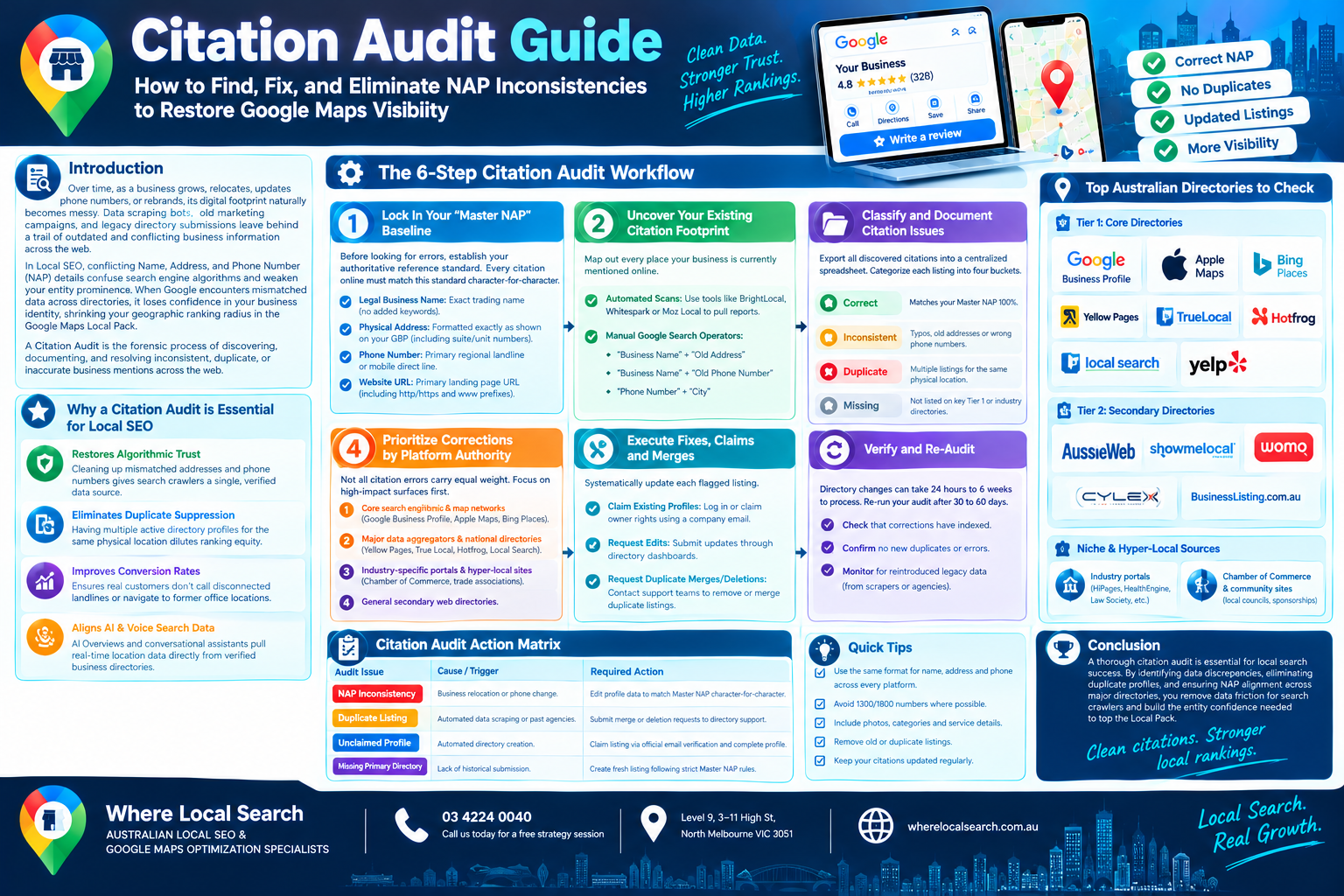
How to Find, Fix, and Eliminate NAP Inconsistencies to Restore Google Maps Visibility
Over time, as a business grows, relocates, updates phone numbers, or rebrands, its digital footprint naturally becomes messy. Data scraping bots, old marketing campaigns, and legacy directory submissions leave behind a trail of outdated and conflicting business information across the web.
In Local SEO, conflicting Name, Address, and Phone Number (NAP) details confuse search engine algorithms and weaken your entity prominence. When Google encounters mismatched data across directories, it loses confidence in your business identity, shrinking your geographic ranking radius in the Google Maps Local Pack.
A Citation Audit is the forensic process of discovering, documenting, and resolving inconsistent, duplicate, or inaccurate business mentions across the web. In this comprehensive guide, we will break down the step-by-step workflow to conduct a complete local citation audit.
Why a Citation Audit is Essential for Local SEO
Cleaning up mismatched addresses and phone numbers gives search crawlers a single, verified data source.
Having multiple active directory profiles for the same physical location dilutes ranking equity.
Ensures real customers don't call disconnected landlines or navigate to former office locations.
AI Overviews and conversational assistants pull real-time location data directly from verified business directories.
The 6-Step Citation Audit Workflow
Step 1: Lock In Your "Master NAP" Baseline
Before looking for errors, establish your authoritative reference standard. Every citation online must match this standard character-for-character:
- Legal Business Name: Exact trading name (no added keywords).
- Physical Address: Formatted exactly as shown on your Google Business Profile (including suite/unit numbers).
- Phone Number: Primary regional landline or mobile direct line.
- Website URL: Primary landing page URL (including correct http/https and www prefixes).
Step 2: Uncover Your Existing Citation Footprint
Map out every place your business is currently mentioned online:
- Automated Scans: Use citation audit software (e.g., BrightLocal, Whitespark, or Moz Local) to pull automated reports across major platforms.
- Manual Google Search Operators: Perform targeted manual queries to uncover hidden or unindexed mentions:
"Business Name" + "Old Address"
"Business Name" + "Old Phone Number"
"Phone Number" + "City"
Step 3: Classify and Document Citation Issues
Export all discovered citations into a centralized spreadsheet tracking worksheet. Categorize every listing into four main buckets:
Step 4: Prioritize Corrections by Platform Authority
Not all citation errors carry equal weight. Focus your editing efforts on high-impact surfaces first:
- Priority 1: Core search engines & map networks (Google Business Profile, Apple Maps, Bing Places).
- Priority 2: Major data aggregators and core national directories (Yellow Pages, True Local, Hotfrog, Local Search).
- Priority 3: Industry-specific portals and hyper-local Chamber of Commerce sites.
- Priority 4: General secondary web directories.
Step 5: Execute Fixes, Claims, and Merges
Systematically update each flagged listing:
- Claim Existing Profiles: Log into or claim owner rights for unclaimed directory listings using a company email address.
- Request Edits: Submit profile updates through directory dashboards to align data with your Master NAP.
- Request Duplicate Merges/Deletions: Contact directory support teams to delete or merge duplicate listings so that only one authoritative profile remains per location.
Step 6: Verify and Re-Audit
Directory changes can take anywhere from 24 hours to 6 weeks to process. Re-run your citation audit tool after 30 to 60 days to confirm that corrections have indexed successfully and that automated scrapers haven't re-introduced legacy errors.
Citation Audit Action Matrix
| Audit Issue | Cause / Trigger | Required Action |
|---|---|---|
| NAP Inconsistency | Business relocation or phone change. | Edit profile data to match Master NAP character-for-character. |
| Duplicate Listing | Automated data scraping or past agencies. | Submit merge or deletion requests to directory support. |
| Unclaimed Profile | Automated directory creation. | Claim listing via official email verification and complete profile. |
| Missing Primary Directory | Lack of historical submission. | Create fresh listing following strict Master NAP rules. |
Conclusion
A thorough citation audit is an essential maintenance task for any local business serious about dominating Google Maps. By identifying data discrepancies, eliminating duplicate profiles, and establishing strict NAP alignment across major Australian directories, you remove data friction for search engines and build the entity confidence required to top the Local Pack.
Forensic citation discovery, contacting manual directory support teams, merging stubborn duplicate profiles, and maintaining long-term data hygiene requires dedicated technical focus.
If you want to clean up your digital footprint and build an authoritative Local SEO foundation across Australia, the expert team at Where Local Search is here to manage the process end-to-end. As leading specialists in Australian Local SEO and Google Maps optimization, we build structured systems that convert digital entity trust directly into long-term commercial growth.