
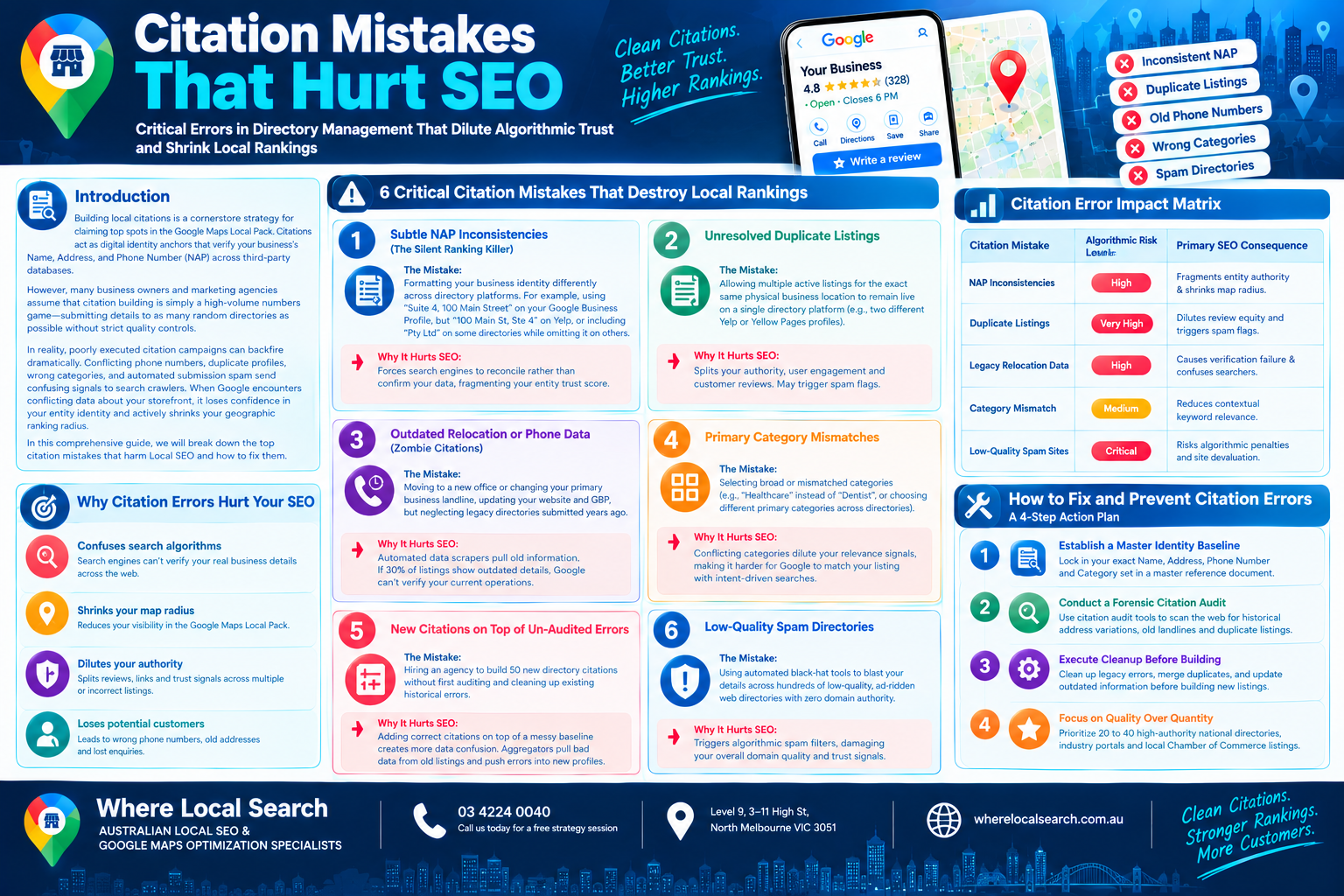
Critical Errors in Directory Management That Dilute Algorithmic Trust and Shrink Local Rankings
Building local citations is a cornerstone strategy for claiming top spots in the Google Maps Local Pack. Citations act as digital identity anchors that verify your business’s Name, Address, and Phone Number (NAP) across third-party databases.
However, many business owners and marketing agencies assume that citation building is simply a high-volume numbers game—submitting details to as many random directories as possible without strict quality controls.
In reality, poorly executed citation campaigns can backfire dramatically. Conflicting phone numbers, duplicate profiles, wrong categories, and automated submission spam send confusing signals to search crawlers. When Google encounters conflicting data about your storefront, it loses confidence in your entity identity and actively shrinks your geographic ranking radius.
In this comprehensive guide, we will break down the top citation mistakes that harm Local SEO and how to fix them.
6 Critical Citation Mistakes That Destroy Local Rankings
1. Subtle NAP Inconsistencies (The Silent Ranking Killer)
The Mistake: Formatting your business identity differently across directory platforms. For example, using "Suite 4, 100 Main Street" on your Google Business Profile, but "100 Main St, Ste 4" on Yelp, or including "Pty Ltd" on some directories while omitting it on others.
💡 Why It Hurts SEO: While search algorithms have improved at resolving minor abbreviations, cumulative formatting variations force search engines to reconcile rather than confirm your data. This uncertainty fragments your entity trust score.
2. Unresolved Duplicate Listings
The Mistake: Allowing multiple active listings for the exact same physical business location to remain live on a single directory platform (e.g., two different Yelp or Yellow Pages profiles).
💡 Why It Hurts SEO: Duplicate profiles split your authority, user engagement, and customer reviews across multiple URLs. Search crawlers view duplicate listings as potentially deceptive or spammy, often penalizing all associated listings.
3. Outdated Relocation or Phone Data (Zombie Citations)
The Mistake: Moving to a new office or changing your primary business landline, updating your website and Google Business Profile, but neglecting legacy directories submitted years ago.
💡 Why It Hurts SEO: Automated data scraping bots continuously pull information from legacy platforms and pass old addresses to major search indexes. If 30% of web citations list an old phone number, Google cannot confidently verify your current operational status.
4. Primary Category Mismatches
The Mistake: Selecting broad or mismatched business categories during directory submissions (e.g., selecting generic "Healthcare" instead of "Dentist", or choosing different primary categories across directories).
💡 Why It Hurts SEO: Business categories pass strong contextual relevance signals. Selecting conflicting categories dilutes your primary service relevance, making it harder for Google to match your listing with intent-driven local queries.
5. Building New Citations on Top of Un-Audited Errors
The Mistake: Hiring an agency to build 50 new directory citations without first auditing and cleaning up existing historical errors.
💡 Why It Hurts SEO: Adding correct citations on top of a messy historical baseline creates more data confusion. Automated directory aggregators pull bad data from old listings and push errors straight into your newly created directory profiles.
6. Submitting to Low-Quality Spam Directories
The Mistake: Using automated black-hat tools to blast your business details across hundreds of low-quality, ad-ridden web directories with zero domain authority.
💡 Why It Hurts SEO: Google evaluates citation authority. Links and data coming from toxic, spammy directories trigger algorithmic spam filters, damaging your overall domain quality.
Citation Error Impact Matrix
| Citation Mistake | Algorithmic Risk Level | Primary SEO Consequence |
|---|---|---|
| NAP Inconsistencies | High | Fragments entity authority & shrinks map radius. |
| Duplicate Listings | Very High | Dilutes review equity and triggers spam flags. |
| Legacy Relocation Data | High | Causes verification failure & confuses searchers. |
| Category Mismatch | Medium | Reduces contextual keyword relevance. |
| Low-Quality Spam Sites | Critical | Risks algorithmic penalties and site devaluation. |
How to Fix and Prevent Citation Errors: A 4-Step Action Plan
1. Establish a Master Identity Baseline: Lock in your exact Name, Address, Phone Number, and Category set in a master reference document. Copy and paste directly from this document during all future submissions.
2. Conduct a Forensic Citation Audit: Use specialized audit tools to scan the web for historical address variations, old landlines, and duplicate listings.
3. Execute Cleanup Before Building: Clean up legacy errors, merge duplicate profiles, and update outdated contact information before building new listings.
4. Focus on Quality Over Quantity: Prioritize 20 to 40 high-authority national directories, industry-specific portals, and local Chamber of Commerce listings over hundreds of cheap web directories.
Conclusion
In Local SEO, citation quality and accuracy far outweigh sheer volume. By eliminating NAP inconsistencies, merging duplicate listings, updating legacy contact information, and focusing exclusively on authoritative directory platforms, you eliminate algorithmic friction and give search engines the confidence needed to rank your business at the top of the Google Maps Local Pack.
Auditing messy historical data, contacting manual directory support teams to remove duplicates, and maintaining ongoing citation hygiene requires systematic technical execution.
If you want to audit your citation network, clean up messy business data, and build an authoritative Local SEO footprint across Australia, the expert team at Where Local Search is here to manage the process end-to-end. As premier specialists in Australian Local SEO and Google Maps optimization, we build structured systems that turn digital entity trust directly into long-term commercial growth.