
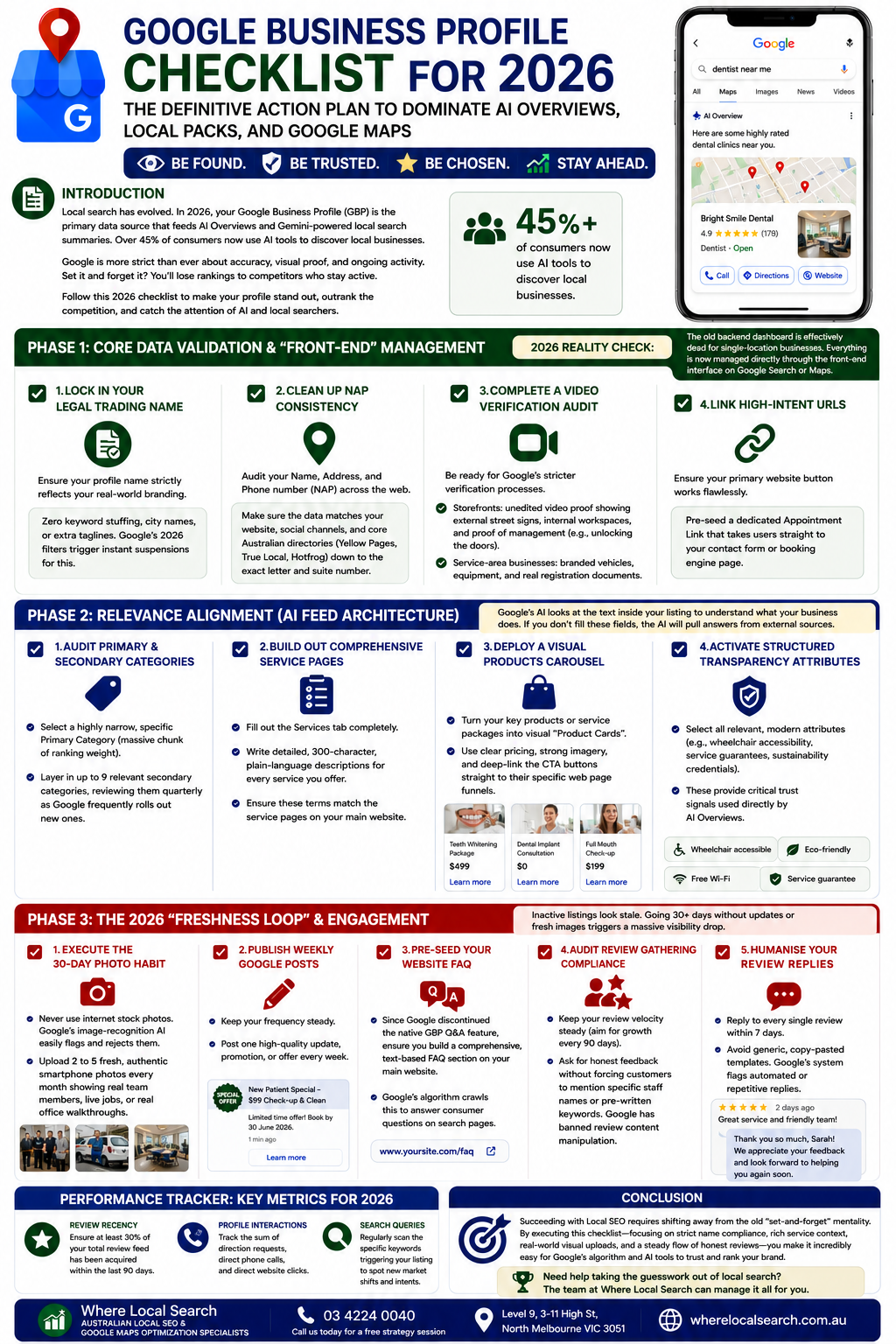
The Definitive Action Plan to Dominate AI Overviews, Local Packs, and Google Maps
Local search has undergone its biggest evolution yet. In 2026, your Google Business Profile (GBP) is no longer just a static directory listing on Google Maps—it has transformed into the primary data source that trains Google’s AI Overviews and Gemini-powered local search summaries. In fact, industry surveys show that over 45% of consumers now use AI tools to discover local businesses.
Because of this, Google has become incredibly strict about profile accuracy, visual proof, and continuous activity. Setting up your profile once and letting it sit dormant is a guaranteed way to lose your rankings to more active local competitors.
To ensure your digital storefront stands out, outranks the competition, and catches the attention of AI search engines this year, follow this comprehensive 2026 Google Business Profile Checklist.
Phase 1: Core Data Validation & "Front-End" Management
⚠️ 2026 Reality Check: The old backend dashboard is effectively dead for single-location businesses. Everything is now managed directly through the front-end interface on Google Search or Maps when logged in as the owner.
Ensure your profile name strictly reflects your real-world branding. Absolutely zero keyword stuffing, city names, or extra taglines added to the title, as Google's automated filters trigger instant suspensions for this.
Audit your Name, Address, and Phone number (NAP) across the web. Make sure data matches your website, social channels, and core Australian directories (Yellow Pages, True Local, Hotfrog) down to the exact letter and suite number.
Be ready for Google's stricter verification processes. Storefront businesses must have unedited video proof showing external street signs, internal workspaces, and proof of management (e.g., unlocking doors). Service-area businesses must show branded vehicles, equipment, and registration documents.
Ensure your primary website button works flawlessly, and pre-seed a dedicated Appointment Link that takes users straight to your contact form or booking engine page.
Phase 2: Relevance Alignment (AI Feed Architecture)
Google’s AI looks at the text inside your listing to understand what your business actually does. If you don't fill these fields, AI will pull answers from external web sources without your control.
Select a highly narrow, specific Primary Category (accounts for a massive chunk of ranking weight). Layer in up to 9 relevant secondary categories, reviewing them quarterly as Google regularly rolls out new options.
Fill out the Services tab completely. Write detailed, 300-character, plain-language descriptions for every single service you offer. Ensure these terms match the service pages on your main website.
Turn your key products or service packages into visual "Product Cards". Use clear pricing, strong imagery, and deep-link the CTA buttons straight to their specific web page funnels.
Select all relevant modern attributes (e.g., wheelchair accessibility, service guarantees, sustainability credentials). These provide critical trust signals used directly by AI Overviews.
Phase 3: The 2026 "Freshness Loop" & Engagement
A major shift is how quickly an inactive listing looks stale to the algorithm. Going 30+ days without any updates or fresh images triggers a massive visibility drop.
Never use internet stock photos, as Google’s image-recognition AI easily flags and rejects them. Upload 2 to 5 fresh, authentic smartphone photos every month showing real team members, live jobs, or real office walkthroughs.
Keep your frequency steady. Post one high-quality update, promotion, or offer every week, as consistent post frequency is now a direct ranking signal.
Since Google discontinued the native GBP Q&A feature, ensure you build a comprehensive, text-based FAQ section on your main website. Google's algorithm crawls this to answer consumer questions directly on search pages.
Keep review velocity steady (aim for growth every 90 days). Make sure your team asks for honest feedback without forcing customers to mention specific staff names or pre-written keywords, avoiding review manipulation flags.
Reply to every single review within 7 days. Avoid using generic, copy-pasted templates, as Google’s system flags automated or repetitive replies.
Performance Tracker: Key Metrics for 2026
Ensure at least 30% of your total review feed has been acquired within the last 90 days.
Track the sum of direction requests, direct phone calls, and direct website clicks.
Regularly scan the specific keywords triggering your listing to spot new market shifts and consumer intents.
Conclusion
Succeeding with Local SEO requires shifting away from the old "set-and-forget" mentality. By consistently executing this checklist—focusing on strict name compliance, rich service context, real-world visual uploads, and maintaining a steady flow of honest reviews—you make it incredibly easy for Google's algorithm and AI tools to trust and rank your brand.
Keeping up with weekly posts, monthly photo audits, dynamic category changes, and maintaining strict NAP consistency across dozens of online networks is highly demanding when you are focused on serving your clients.
If you want to take the guesswork out of your local search presence and ensure your listing perfectly targets every single 2026 ranking lever, the team at Where Local Search is here to handle it all for you. As premier Australian Local SEO and Google Maps optimization specialists, we actively manage and scale your digital assets so you can focus on what you do best: growing your business.