
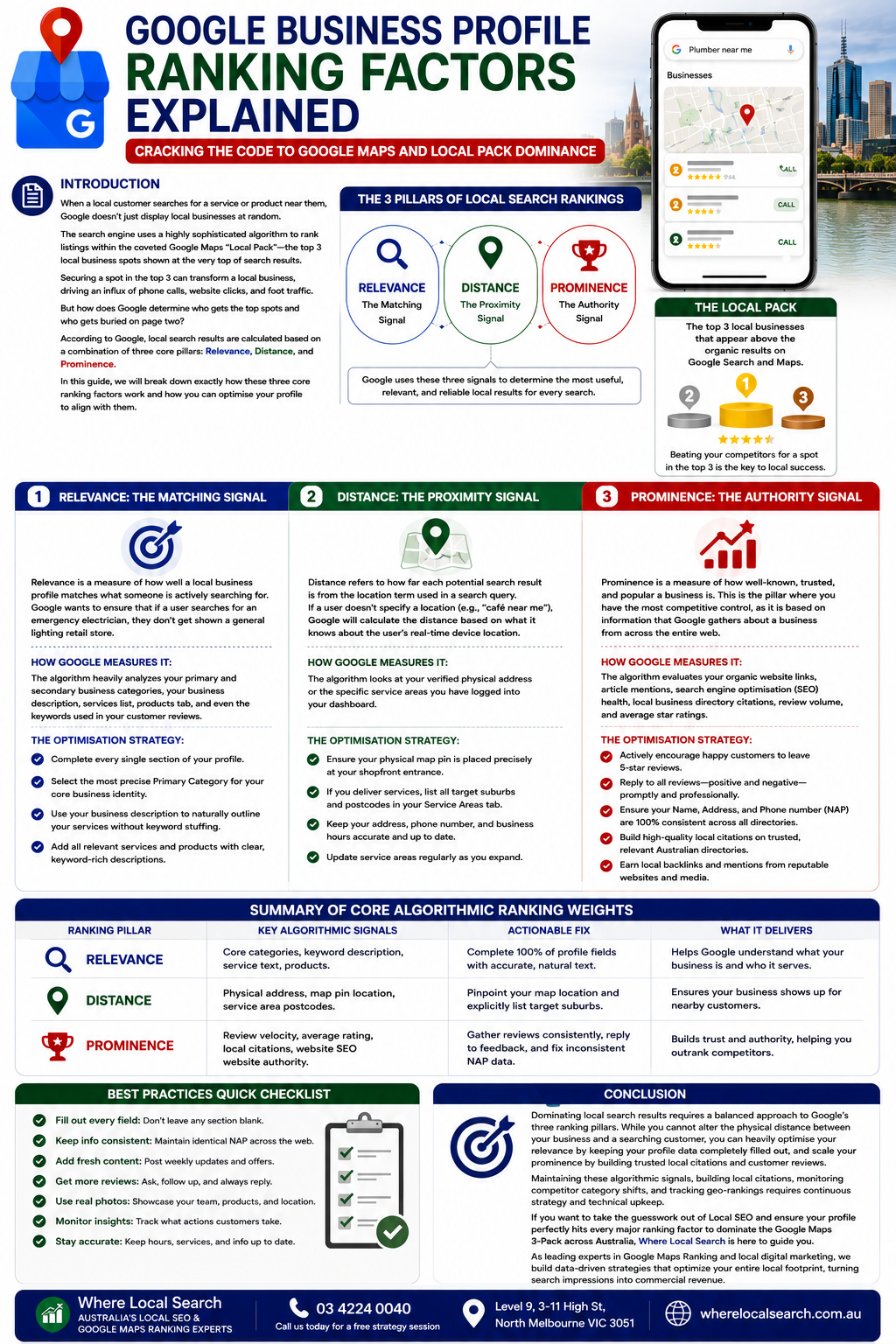
Cracking the Code to Google Maps and Local Pack Dominance
When a local customer searches for a service or product near them, Google doesn't just display local businesses at random. The search engine uses a highly sophisticated algorithm to rank listings within the coveted Google Maps "Local Pack"—the top 3 local business spots shown at the very top of search results.
Securing a spot in the top 3 can transform a local business, driving an influx of phone calls, website clicks, and foot traffic. But how does Google determine who gets the top spots and who gets buried on page two?
According to Google, local search results are calculated based on a combination of three core pillars: Relevance, Distance, and Prominence. In this guide, we will break down exactly how these three core ranking factors work and how you can optimise your profile to align with them.
The 3 Pillars of Local Search Rankings
1. Relevance: The Matching Signal
Relevance is a measure of how well a local business profile matches what someone is actively searching for. Google wants to ensure that if a user searches for an emergency electrician, they don't get shown a general lighting retail store.
How Google Measures It: The algorithm heavily analyzes your primary and secondary business categories, your business description, services list, products tab, and even the keywords used in your customer reviews.
💡 The Optimisation Strategy: Complete every single section of your profile. Select the most precise Primary Category for your core business identity, and use your business description to naturally outline your services without keyword stuffing.
2. Distance: The Proximity Signal
Distance refers to how far each potential search result is from the location term used in a search query. If a user doesn't specify a location (e.g., typing "café near me"), Google will calculate the distance based on what it knows about the user's real-time device location.
How Google Measures It: The algorithm looks at your verified physical address or the specific service areas you have logged into your dashboard.
💡 The Optimisation Strategy: While you cannot control where a customer is standing when they search, you can control your data accuracy. Ensure your physical map pin is placed precisely at your shopfront entrance, or precisely list your target postcodes and suburbs in your Service Areas tab if you deliver services to clients.
3. Prominence: The Authority Signal
Prominence is a measure of how well-known, trusted, and popular a business is. This is the pillar where you have the most competitive control, as it is based on information that Google gathers about a business from across the entire web.
How Google Measures It: The algorithm evaluates your organic website links, article mentions, search engine optimization (SEO) health, local business directory citations, review volume, and average star ratings.
💡 The Optimisation Strategy: Build an ironclad online reputation. Actively encourage happy customers to leave 5-star reviews and reply to them promptly. Additionally, keep your Name, Address, and Phone number (NAP) 100% consistent across trusted directories like Yellow Pages Australia, True Local, and Yelp.
Summary of Core Algorithmic Ranking Weights
| Ranking Pillar | Key Algorithmic Signals | Actionable Fix |
|---|---|---|
| Relevance | Core categories, keyword description, service text, products. | Complete 100% of profile fields with accurate, natural text. |
| Distance | Physical address, map pin location, service area postcodes. | Pinpoint your map location and explicitly list target suburbs. |
| Prominence | Review velocity, average rating, local citations, website SEO authority. | Gather reviews consistently, reply to feedback, and fix inconsistent NAP data. |
Conclusion
Dominating local search results requires a balanced approach to Google’s three ranking pillars. While you cannot alter the physical distance between your business and a searching customer, you can heavily optimise your relevance by keeping your profile data completely filled out, and scale your prominence by building trusted local citations and customer reviews.
Maintaining these algorithmic signals, building local citations, monitoring competitor category shifts, and tracking geo-rankings requires continuous strategy and technical upkeep.
If you want to take the guesswork out of Local SEO and ensure your profile perfectly hits every major ranking factor to dominate the Google Maps 3-Pack across Australia, Where Local Search is here to guide you. As leading experts in Google Maps Ranking and local digital marketing, we build data-driven strategies that optimize your entire local footprint, turning search impressions into commercial revenue.