
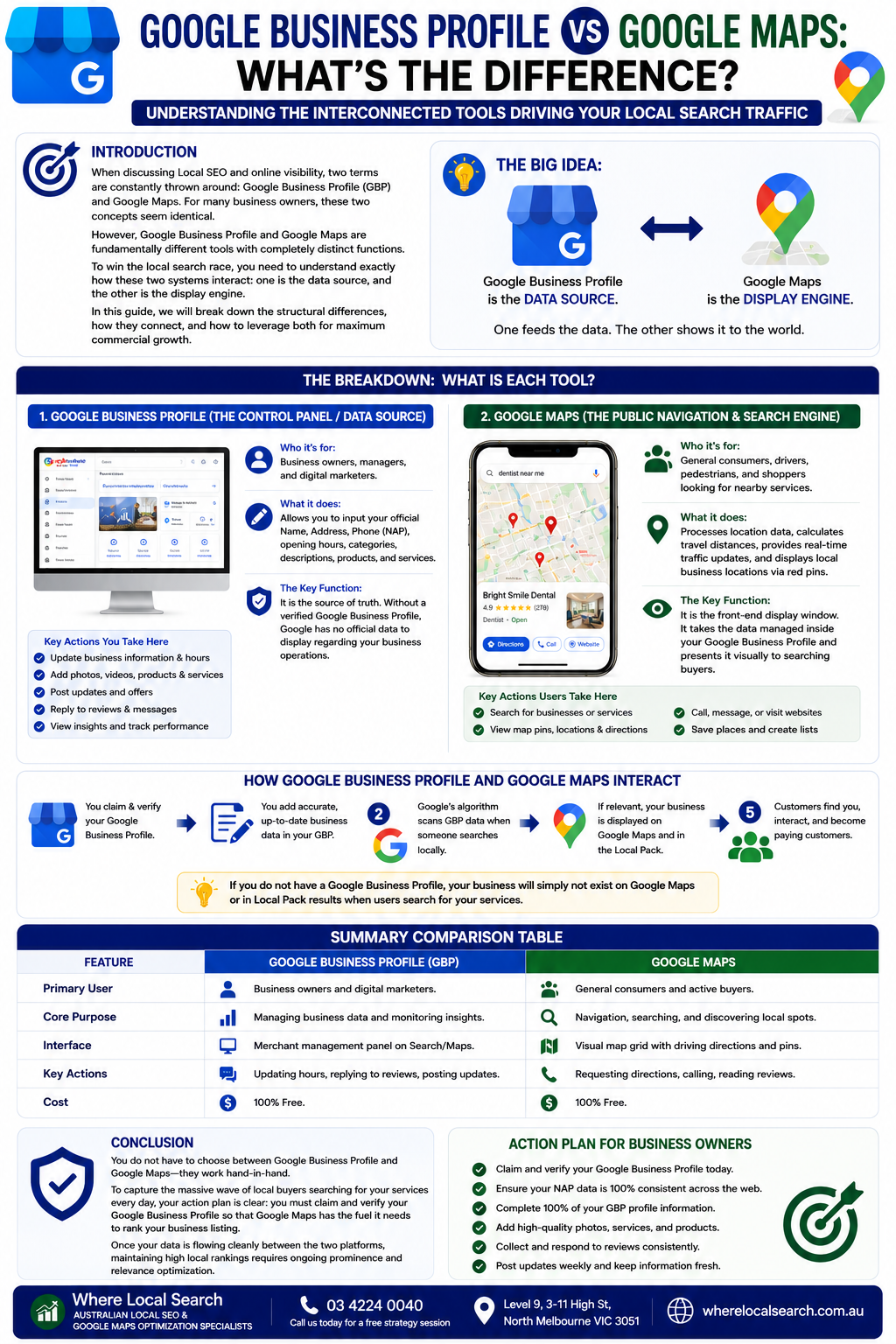
Understanding the Interconnected Tools Driving Your Local Search Traffic
When discussing Local SEO and online visibility, two terms are constantly thrown around: Google Business Profile (GBP) and Google Maps. For many business owners, these two concepts seem identical. It is easy to see why—when you look up a local business, you see a map interface paired with business information.
However, Google Business Profile and Google Maps are fundamentally different tools with completely distinct functions.
Conflating the two can lead to a confused local marketing strategy. To win the local search race, you need to understand exactly how these two systems interact: one is the data source, and the other is the display engine. In this guide, we will break down the structural differences, how they connect, and how to leverage both for maximum commercial growth.
The Breakdown: What Is Each Tool?
1. Google Business Profile (The Control Panel / Data Source)
Google Business Profile (formerly Google My Business) is a free dashboard and management tool designed specifically for business owners. It acts as the backend administrative portal where you feed information to Google.
- Who it’s for: Business owners, managers, and digital marketers.
- What it does: It allows you to input your official Name, Address, Phone number (NAP), opening hours, categories, descriptions, products, and services.
- The Key Function: It is the source of truth. Without a verified Google Business Profile, Google has no official data to display regarding your business operations.
2. Google Maps (The Public Navigation & Search Engine)
Google Maps is a consumer-facing navigation, mapping, and local search platform utilized by millions of users daily.
- Who it’s for: General consumers, drivers, pedestrians, and shoppers looking for nearby services.
- What it does: It processes location data, calculates travel distances, provides real-time traffic updates, and displays local business locations via red pins.
- The Key Function: It is the front-end display window. It takes the data managed inside your Google Business Profile and presents it visually to searching buyers.
How Google Business Profile and Google Maps Interact
To understand their relationship, think of Google Business Profile as the backstage director and Google Maps as the front-stage performance.
When a user opens Google Maps and types "dentist near me" or "best café Melbourne," Google’s local search algorithm springs into action. It scans the database of verified Google Business Profiles to find listings that match the user’s request.
If your Google Business Profile is completely filled out, categorized correctly, and active, the algorithm will pull your data and display your business pin prominently on Google Maps. If you do not have a GBP, your business will simply not exist on the map screen when users look for your services.
Summary Comparison Table
| Feature | Google Business Profile (GBP) | Google Maps |
|---|---|---|
| Primary User | Business owners and digital marketers. | General consumers and active buyers. |
| Core Purpose | Managing business data and monitoring insights. | Navigation, searching, and discovering local spots. |
| Interface | Merchant management panel on Search/Maps. | Visual map grid with driving directions and pins. |
| Key Actions | Updating hours, replying to reviews, posting updates. | Requesting directions, calling, reading reviews. |
| Cost | 100% Free. | 100% Free. |
Conclusion & Action Plan for Business Owners
You do not have to choose between Google Business Profile and Google Maps—they work hand-in-hand. To capture the massive wave of local buyers searching for your services every day, your action plan is clear: you must claim and verify your Google Business Profile so that Google Maps has the fuel it needs to rank your business listing.
Once your data is flowing cleanly between the two platforms, maintaining high local rankings requires ongoing prominence and relevance optimization—such as monitoring competitor categories, scaling review velocity, and updating local citation metrics.