
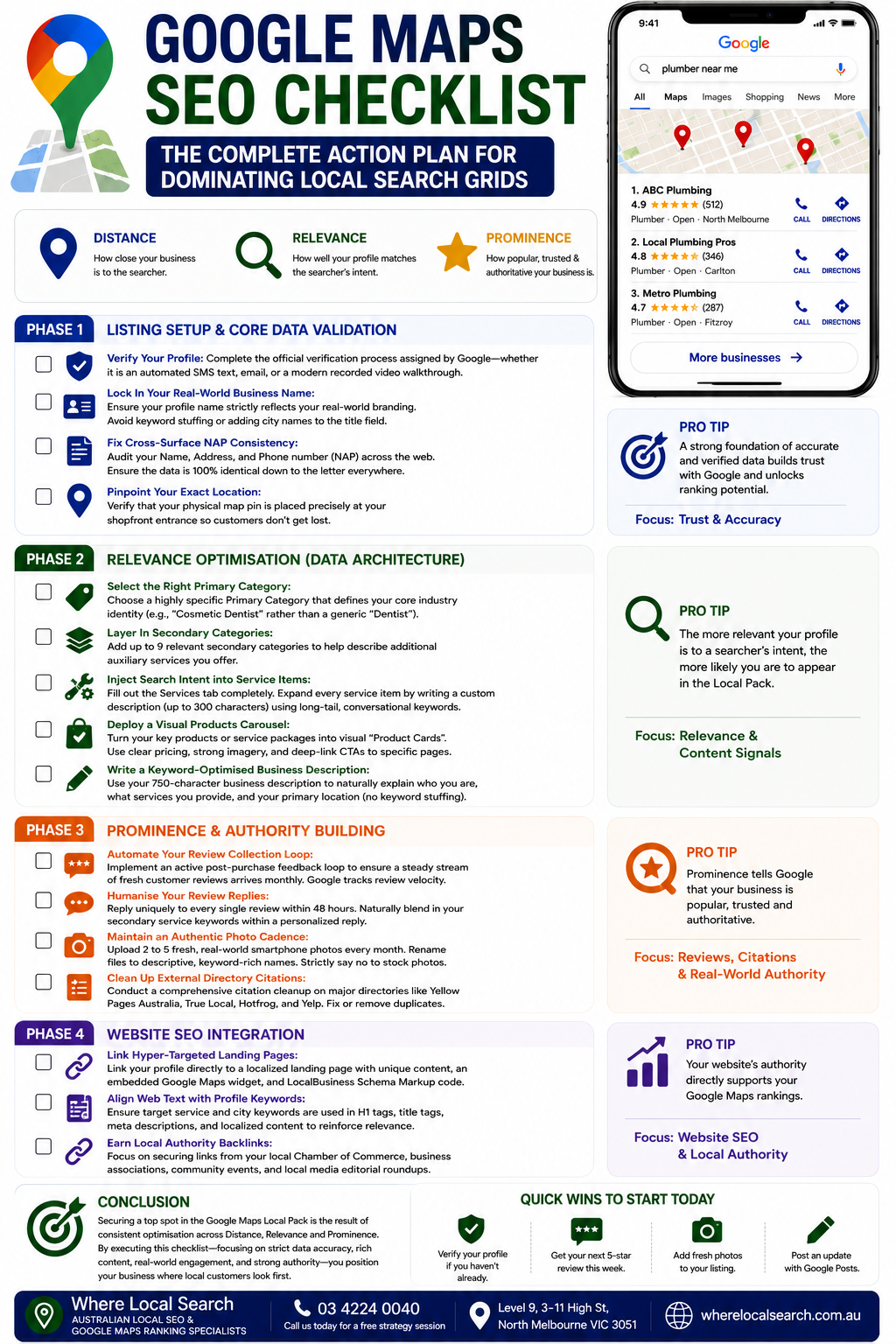
The Complete Action Plan for Dominating Local Search Grids
Appearing on Google Maps is a great first step, but the real commercial value lies in ranking in the top 3 results—known as the Google Maps Local Pack. Statistics show that the top three listings capture over 60% of all local search clicks and phone inquiries. Google Maps ranking isn't driven by luck; it is governed by a specific local algorithm built around Distance, Relevance, and Prominence.
While you cannot alter the physical distance between your business and a searching customer, you can heavily optimise your relevance and scale your prominence to outrank businesses that are physically closer to the searcher than you are.
To ensure your digital storefront safely climbs the ranking ladder, follow this comprehensive Google Maps SEO Checklist.
Phase 1: Listing Setup & Core Data Validation
Google requires absolute data transparency before it gives you a top rank. This phase builds your foundation of algorithmic trust.
Complete the official verification process assigned by Google—whether it is an automated SMS text, email, or a modern recorded video walkthrough of your operational tools and premises. Unverified profiles remain hidden from local search results.
Ensure your profile name strictly reflects your real-world branding. Avoid keyword stuffing or adding city names to the title field, as this violates Google's guidelines and results in a hard suspension.
Audit your Name, Address, and Phone number (NAP) across the web. Ensure the data is 100% identical down to the letter across your website footer, social networks, and trusted online directories.
Verify that your physical map pin is placed precisely at your shopfront entrance so customers navigating local streets don't get lost.
Phase 2: Relevance Optimisation (Data Architecture)
Google crawls your profile's custom text fields to understand exactly what solutions you provide to buyers. This phase directly expands what searches your listing is relevant for.
Choose a highly specific Primary Category that defines your core industry identity (e.g., choose "Cosmetic Dentist" rather than a generic "Dentist" if that is your primary high-intent focus).
Add up to 9 relevant secondary categories to help describe additional auxiliary services you offer.
Fill out the Services tab completely. Expand every single service item by writing a custom description (up to 300 characters), naturally blending in long-tail keywords that match conversational search intent.
Turn your key products or service packages into visual "Product Cards". Use clear pricing, strong imagery, and deep-link the CTA buttons straight to their specific web page funnels.
Use your 750-character business description to naturally explain who you are, what services you provide, and your primary location without falling into keyword stuffing.
Phase 3: Prominence & Authority Building
Prominence is a measure of how well-known, highly trusted, and popular a business is. This is where you build the market authority needed to secure a permanent spot in the Local Pack.
Implement an active post-purchase feedback loop to ensure a steady stream of fresh customer reviews arrives monthly. Google tracks review velocity and recency.
Reply uniquely to every single review within 48 hours. Naturally blend in your secondary service keywords within a personalized, unique reply to signal active profile management.
Upload 2 to 5 fresh, real-world smartphone photos of your team, premises, or completed projects every month. Rename generic file titles to descriptive, keyword-rich names before uploading. Strictly say no to generic stock photography.
Conduct a comprehensive citation cleanup on major national directories like Yellow Pages Australia, True Local, Hotfrog, and Yelp. Eliminate or fix any duplicate listings or outdated phone numbers immediately.
Phase 4: Website SEO Integration
Your website’s health directly impacts your Google Maps visibility. Google continuously crawls your linked website to cross-verify the data on your profile.
Instead of using a generic homepage link, link your profile directly to a localized landing page that features unique content, an embedded Google Maps widget, and hardcoded LocalBusiness Schema Markup code.
Ensure your website features target service and city keywords inside H1 tags, title tags, and localized content pages to heavily reinforce your overall relevance score.
Focus on securing links from your local Chamber of Commerce, neighborhood business associations, community event sponsorships, or local media editorial roundups to signal real-world prominence.
Conclusion
True Google Maps SEO is an ongoing process across relevance, distance, and prominence rather than a one-time technical task. By systematically executing this checklist—focusing on strict name compliance, rich service text signals, real-world visual uploads, and maintaining a steady flow of honest reviews—you position your digital storefront exactly where active buyers look first.
Consistently running local citation cleanups, tracking changing local search grids, monitoring competitor category shifts, and managing data parameters requires ongoing technical execution alongside running your day-to-day operations.
If you want to ensure your business safely dominates the Google Maps Local Pack across Australia, the expert team at Where Local Search is here to manage the process end-to-end. As premier specialists in Local SEO and Google Maps Ranking, we design custom, data-driven strategies that optimize your entire online presence, turning map discovery into long-term commercial revenue.