
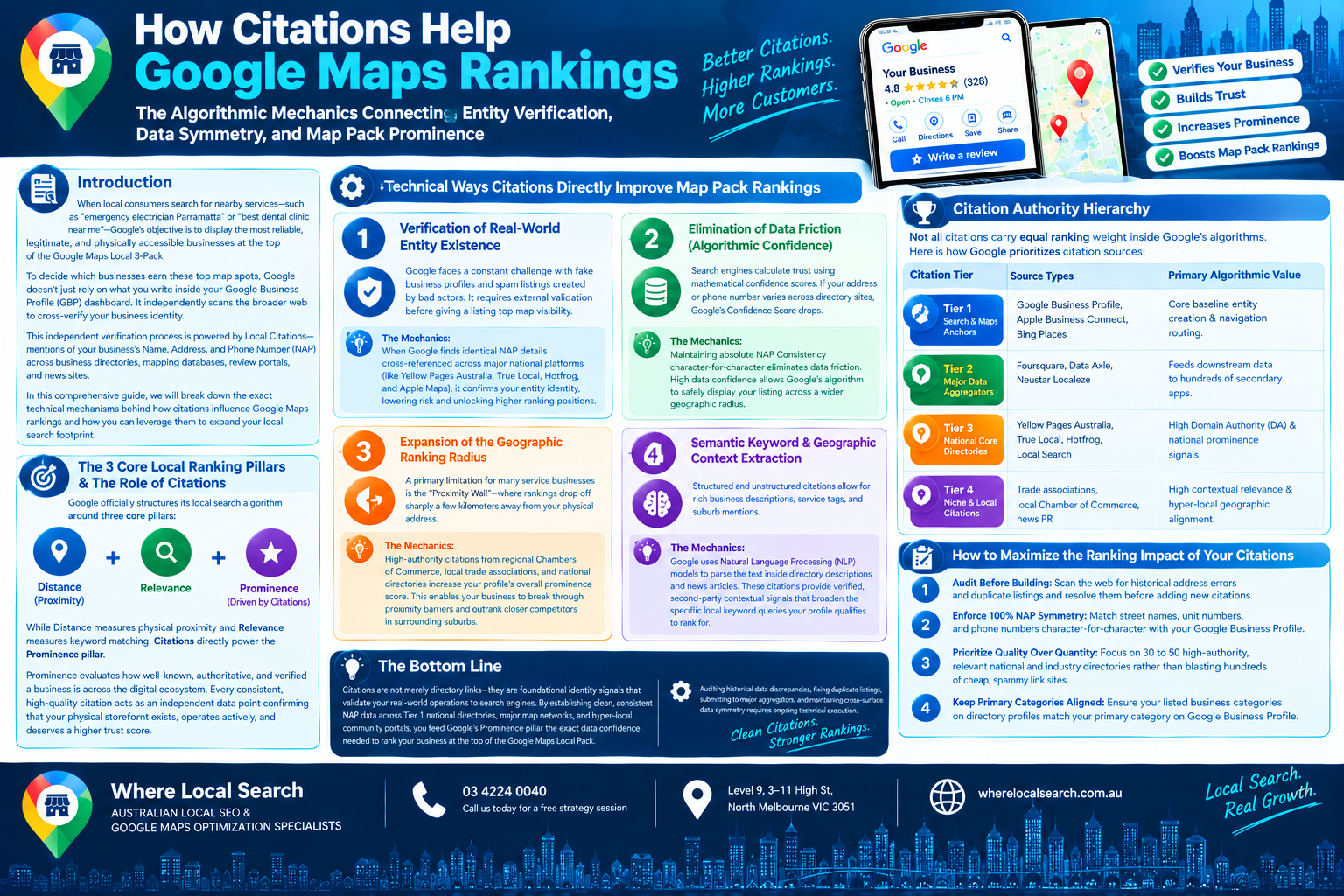
The Algorithmic Mechanics Connecting Entity Verification, Data Symmetry, and Map Pack Prominence
When local consumers search for nearby services—such as "emergency electrician Parramatta" or "best dental clinic near me"—Google’s objective is to display the most reliable, legitimate, and physically accessible businesses at the top of the Google Maps Local 3-Pack.
To decide which businesses earn these top map spots, Google doesn’t just rely on what you write inside your Google Business Profile (GBP) dashboard. It independently scans the broader web to cross-verify your business identity.
This independent verification process is powered by Local Citations—mentions of your business’s Name, Address, and Phone Number (NAP) across business directories, mapping databases, review portals, and news sites.
In this comprehensive guide, we will break down the exact technical mechanisms behind how citations influence Google Maps rankings and how you can leverage them to expand your local search footprint.
The 3 Core Local Ranking Pillars & The Role of Citations
While Distance measures physical proximity to the searcher and Relevance measures keyword matching, Citations directly power the Prominence pillar.
Prominence evaluates how well-known, authoritative, and verified a business is across the digital ecosystem. Every consistent, high-quality citation acts as an independent data point confirming that your physical storefront exists, operates actively, and deserves a higher trust score.
4 Technical Ways Citations Directly Improve Map Pack Rankings
1. Verification of Real-World Entity Existence
Google faces a constant challenge with fake business profiles and spam listings created by bad actors. To protect search quality, the algorithm requires external validation before giving a listing top map visibility.
💡 The Mechanics: When Google finds identical NAP details cross-referenced across major national platforms (like Yellow Pages Australia, True Local, Hotfrog, and Apple Maps), it confirms your entity identity, lowering risk and unlocking higher ranking positions.
2. Elimination of Data Friction (Algorithmic Confidence)
Search engines calculate trust using mathematical confidence scores. If your address or phone number varies across directory sites, Google’s Confidence Score drops.
💡 The Mechanics: Maintaining absolute NAP Consistency character-for-character eliminates data friction. High data confidence allows Google’s algorithm to safely display your listing across a wider geographic radius.
3. Expansion of the Geographic Ranking Radius
A primary limitation for many service businesses is the "Proximity Wall"—where rankings drop off sharply a few kilometers away from their physical address.
💡 The Mechanics: High-authority citations from regional Chambers of Commerce, local trade associations, and national directories increase your profile's overall prominence score. This algorithmic authority enables your business to break through proximity barriers and outrank closer competitors in surrounding suburbs.
4. Semantic Keyword & Geographic Context Extraction
Many structured and unstructured citations allow for rich business descriptions, service tags, and suburb mentions.
💡 The Mechanics: Google uses Natural Language Processing (NLP) models to parse the text inside directory descriptions and news articles. These citations provide verified, second-party contextual signals that broaden the specific local keyword queries your profile qualifies to rank for.
Citation Authority Hierarchy
Not all citations carry equal ranking weight inside Google’s algorithms. Here is how Google prioritizes citation sources:
| Citation Tier | Source Types | Primary Algorithmic Value |
|---|---|---|
| Tier 1: Search & Maps Anchors | Google Business Profile, Apple Business Connect, Bing Places | Core baseline entity creation & navigation routing. |
| Tier 2: Major Data Aggregators | Foursquare, Data Axle, Neustar Localeze | Feeds downstream data to hundreds of secondary apps. |
| Tier 3: National Core Directories | Yellow Pages Australia, True Local, Hotfrog, Local Search | High Domain Authority (DA) & national prominence signals. |
| Tier 4: Niche & Local Citations | Trade associations, local Chamber of Commerce, news PR | High contextual relevance & hyper-local geographic alignment. |
How to Maximize the Ranking Impact of Your Citations
☑ Audit Before Building: Scan the web for historical address errors or duplicate listings and resolve them before adding new citations.
☑ Enforce 100% NAP Symmetry: Match street names, unit numbers, and phone numbers character-for-character with your primary Google Business Profile.
☑ Prioritize Quality Over Quantity: Focus on 30 to 50 high-authority, relevant national and industry directories rather than blasting hundreds of cheap, spammy link sites.
☑ Keep Primary Categories Aligned: Ensure your listed business categories on directory profiles match your primary category on Google Business Profile.
Conclusion
Citations are not merely directory links—they are foundational identity signals that validate your real-world operations to search engines. By establishing clean, consistent NAP data across Tier 1 national directories, major map networks, and hyper-local community portals, you feed Google’s Prominence pillar the exact data confidence needed to rank your business at the top of the Google Maps Local Pack.
Auditing historical data discrepancies, fixing duplicate listings, submitting to major aggregators, and maintaining cross-surface data symmetry requires ongoing technical execution.
If you want to build an authoritative citation foundation and dominate local search results across Australia, the expert team at Where Local Search is here to manage the process end-to-end. As premier specialists in Australian Local SEO and Google Maps optimization, we build structured systems that turn entity trust directly into long-term commercial growth.