
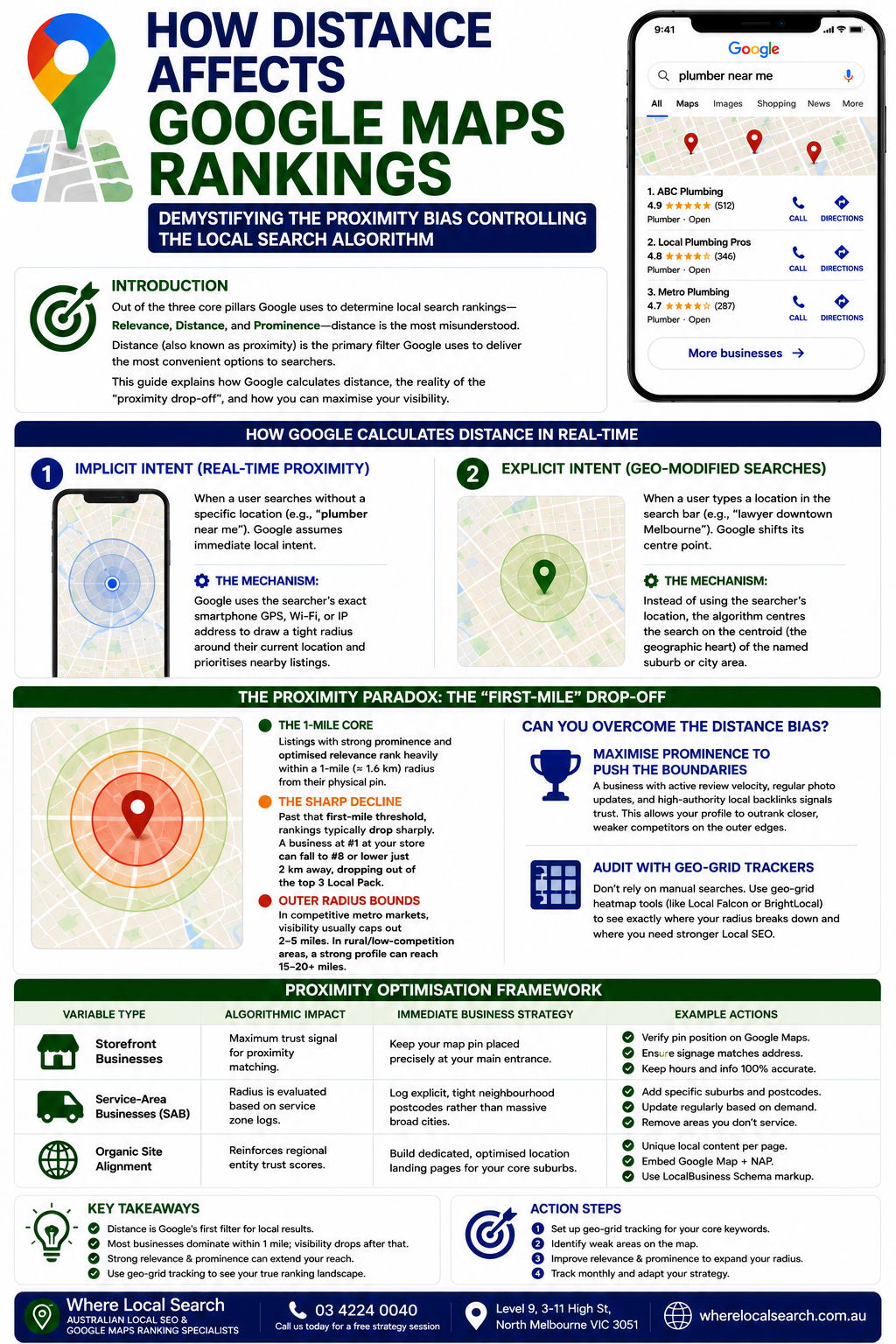
Demystifying the Proximity Bias Controlling the Local Search Algorithm
Out of the three core pillars Google officially uses to determine local search rankings—Relevance, Distance, and Prominence—distance is easily the most misunderstood.
Also referred to as proximity, distance is the primary algorithmic filter Google uses to ensure a user looking for a quick service gets the most convenient option right next to them. Many business owners make the mistake of assuming that if their website has great SEO and their profile has hundreds of 5-star reviews, they will naturally rank across an entire massive city.
However, distance acts as a heavy physical constraint on your map visibility. In this guide, we will break down how Google calculates distance, the reality of the "Proximity Drop-Off," and how you can maximize your visibility within the algorithmic boundaries.
How Google Calculates Distance in Real-Time
Google's algorithm processes distance using two distinct types of user search intent:
1. Implicit Intent (Real-Time Proximity)
When a user searches for a service without naming a specific location (e.g., typing "plumber near me" or simply "dentist"), Google assumes immediate local intent.
💡 The Mechanism: The algorithm automatically tracks the user’s exact smartphone GPS coordinates, Wi-Fi networks, or IP address. It then draws a tight geographic radius around that exact spot and prioritizes listings within walking or short driving distance.
2. Explicit Intent (Geo-Modified Searches)
When a searcher explicitly types a geographic location into the search bar (e.g., "personal injury lawyer downtown Melbourne" or "café in Richmond"), Google shifts its center point.
💡 The Mechanism: Instead of using the searcher's physical location, the algorithm centers the search grid on the centroid (the geographic heart) of the named suburb or city area. Listings closest to that designated center point receive an immediate proximity boost.
The Proximity Paradox: The "First-Mile" Drop-Off
Data from local search studies reveals a crucial pattern in how distance affects visibility, known as the rule of exponential decay:
Listings with strong prominence and optimized relevance tend to rank heavily within a 1-mile (roughly 1.6 km) radius from their physical office pin.
Once a user moves past that first-mile threshold, rankings typically experience a sharp drop-off. A business sitting at Rank #1 at their entrance can plummet to Rank #8 just 2 km away.
In dense metro markets, effective visibility caps between 2 to 5 miles. In rural or low-density regions, strong profiles can stretch 15 to 20+ miles out.
Can You Overcome the Distance Bias?
While you cannot legally pack up and move your physical office building closer to every searching buyer, you can strategically use Relevance and Prominence to expand your ranking radius as wide as the algorithm allows:
A business with an active review velocity, regular smartphone photo updates, and high-authority local website backlinks signals immense trust to Google. This authority allows your profile to beat out closer, low-quality competitors on the outer edges of your search grid.
Stop relying on static manual searches from your desktop. Deploy modern geo-grid heatmap tracking software (like Local Falcon or BrightLocal) to see exactly where your distance radius breaks down and where you need to apply heavier Local SEO reinforcement.
Proximity Optimization Framework
| Variable Type | Algorithmic Impact | Immediate Business Strategy |
|---|---|---|
| Storefront Businesses | Maximum trust signal for proximity matching. | Keep your map pin placed precisely at your main entrance. |
| Service-Area Businesses (SAB) | Radius is evaluated based on service zone logs. | Log explicit, tight neighborhood postcodes rather than massive broad cities. |
| Organic Site Alignment | Reinforces regional entity trust scores. | Build dedicated, optimized location landing pages for your core suburbs. |
Conclusion
Distance is a foundational ranking driver on Google Maps, acting as a natural geographic boundary for your local search real estate. While you cannot change your real-world proximity to every client, understanding that your visibility naturally declines past the first mile allows you to stop guessing and start building strategic local authority to pull in customers from the widest radius possible.
Managing multi-layered geo-grid data tracking, deploying localized backend schemas, monitoring competitive edge shifts, and driving review velocity takes significant technical execution alongside handling your daily storefront operations.
If you want to maximize your local coverage and ensure your digital footprint is perfectly optimized to stretch your Google Maps ranking radius across Australia, the team at Where Local Search is here to manage it all for you. As leading experts in Australian Local SEO and Google Maps optimization, we take over the technical heavy lifting—safely growing your prominence and converting local impressions directly into business revenue.