
Inside the Core Pillars of Google’s Local Search Algorithm
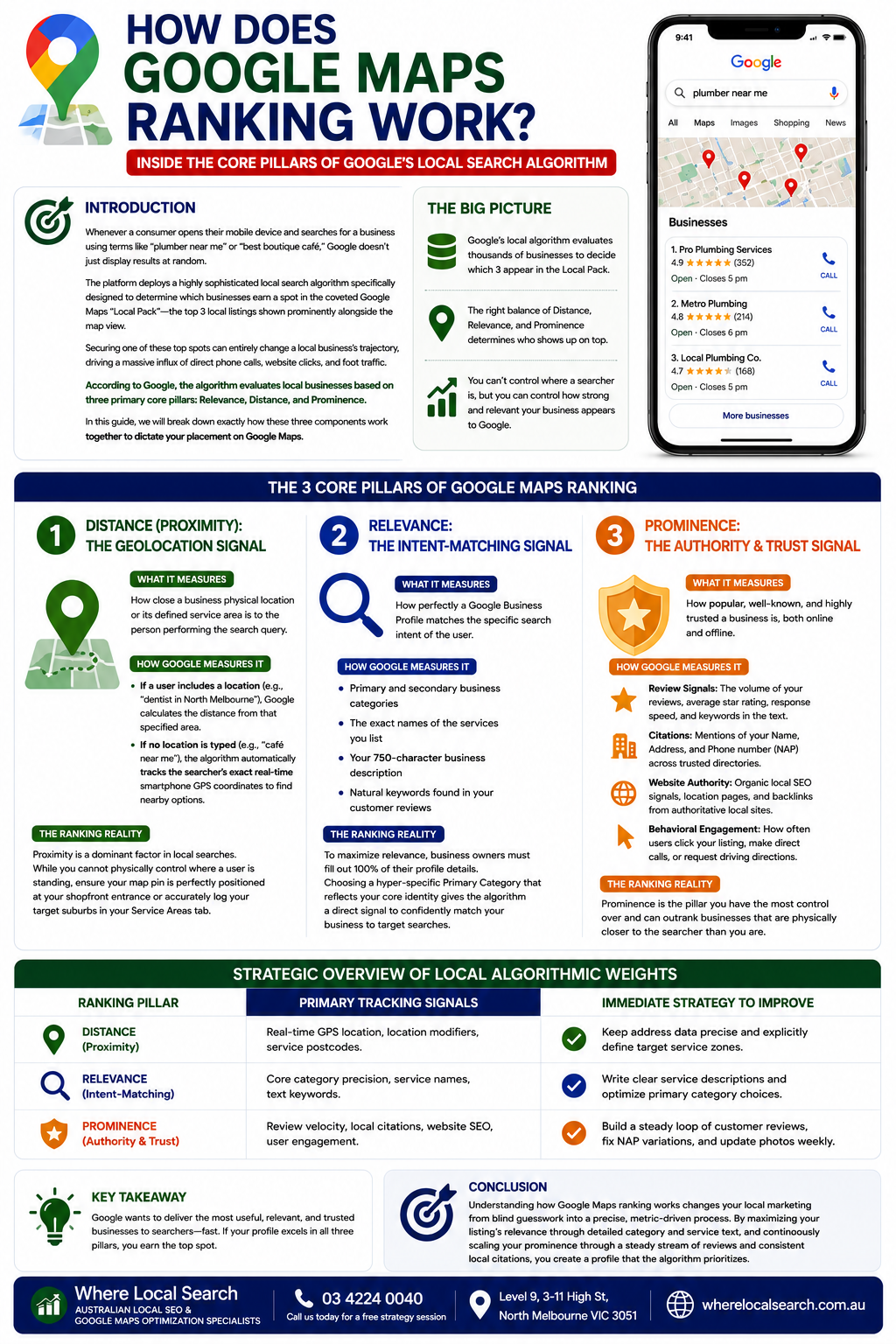
Whenever a consumer opens their mobile device and searches for a business using terms like "plumber near me" or "best boutique café," Google doesn't just display results at random. The platform deploys a highly sophisticated local search algorithm specifically designed to determine which businesses earn a spot in the coveted Google Maps "Local Pack"—the top 3 local listings shown prominently alongside the map view.
Securing one of these top spots can entirely change a local business's trajectory, driving a massive influx of direct phone calls, website clicks, and foot traffic. But how does Google actually decide which profile ranks at the top?
According to Google, the algorithm evaluates local businesses based on three primary core pillars: Relevance, Distance, and Prominence. In this guide, we will break down exactly how these three components work together to dictate your placement on Google Maps.
The 3 Core Pillars of Google Maps Ranking
1. Distance (Proximity): The Geolocation Signal
Distance refers to how close a business physical location or its defined service area is to the person performing the search query.
How Google Measures It: If a user includes a location in their search (e.g., "dentist in North Melbourne"), Google calculates the distance from that specified area. If no location is typed (e.g., "café near me"), the algorithm automatically tracks the searcher's exact real-time smartphone GPS coordinates to find nearby options.
💡 The Ranking Reality: Proximity is a dominant factor in local searches. While you cannot physically control where a user is standing when they look for a business, you must ensure your data is accurate by keeping your map pin perfectly positioned at your shopfront entrance or accurately logging your target suburbs inside your Service Areas tab.
2. Relevance: The Intent-Matching Signal
Relevance measures how perfectly a Google Business Profile matches the specific search intent of the user. Google wants to ensure that a searcher looking for a vegan bakery isn't shown a general grocery store or standard meat market.
How Google Measures It: The algorithm relies heavily on the text data and attributes seeded directly within your listing. It evaluates your Primary and Secondary business categories, the exact names of the individual services you list, your 750-character business description, and even the natural keywords left by customers inside your review feed.
💡 The Ranking Reality: To maximize relevance, business owners must fill out 100% of their profile details. Choosing a hyper-specific Primary Category that reflects your core identity gives the algorithm a direct signal to confidently match your business to target searches.
3. Prominence: The Authority and Trust Signal
Prominence measures how popular, well-known, and highly trusted a business is, both online and offline. While distance is hard to alter, Prominence is the pillar where you have the most competitive control to outrank businesses that are physically closer to the searcher than you are.
How Google Measures It: Google evaluates information it gathers across the wider web, including:
- Review Signals: The absolute volume of your reviews, the average star rating, your response speed, and the presence of natural service keywords inside the text.
- Citations: Mentions of your Name, Address, and Phone number (NAP) across trusted business directories.
- Website Authority: Organic local SEO signals, dedicated location pages, and backlink strength coming from authoritative local sites (like local news or chambers of commerce).
- Behavioral Engagement: How often users click your listing, make direct calls, or request driving directions.
Strategic Overview of Local Algorithmic Weights
| Ranking Pillar | Primary Tracking Signals | Immediate Strategy to Improve |
|---|---|---|
| Distance | Real-time GPS location, location modifiers, service postcodes. | Keep address data precise and explicitly define target service zones. |
| Relevance | Core category precision, service names, text keywords. | Write clear service descriptions and optimize primary category choices. |
| Prominence | Review velocity, local citations, website SEO, user engagement. | Build a steady loop of customer reviews, fix NAP variations, and update photos weekly. |
Conclusion
Understanding how Google Maps ranking works changes your local marketing from blind guesswork into a precise, metric-driven process. By maximizing your listing's relevance through detailed category and service text, and continuously scaling your prominence through a steady stream of reviews and consistent local citations, you create a profile that the algorithm prioritizes.
Consistently running citation cleanup audits, tracking local keyword movements across dynamic geo-grids, and adjusting profile data to match algorithm updates takes significant upkeep alongside managing daily business tasks.
If you want to ensure your digital storefront perfectly hits every major ranking lever to dominate the Google Maps Local Pack across Australia, the team at Where Local Search is ready to manage it for you. As dedicated specialists in Australian Local SEO and Google Maps optimization, we systematically scale your visibility to turn map impressions directly into sustainable commercial growth.