
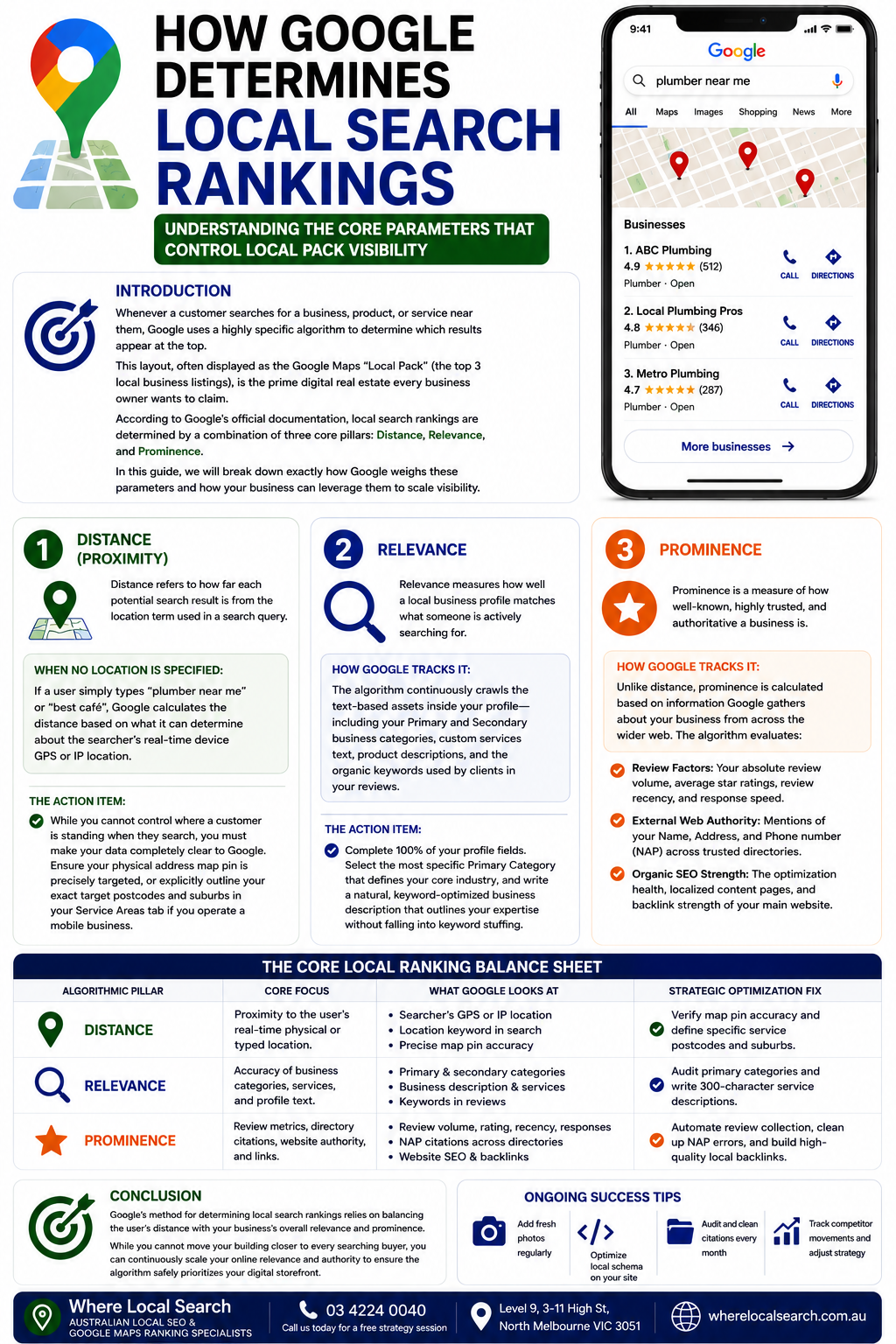
Understanding the Core Parameters That Control Local Pack Visibility
Whenever a customer searches for a business, product, or service near them, Google uses a highly specific algorithm to determine which results appear at the top. This layout, often displayed as the Google Maps "Local Pack" (the top 3 local business listings), is the prime digital real estate every business owner wants to claim.
However, Google does not rank local businesses based on who pays the most or who has the oldest website. Instead, the local search algorithm focuses heavily on serving the most helpful, trustworthy, and physically relevant solution to the user.
According to Google's official documentation, local search rankings are determined by a combination of three core pillars: Distance, Relevance, and Prominence. In this guide, we will break down exactly how Google weighs these parameters and how your business can leverage them to scale visibility.
The 3 Pillars of Local Search Rankings
1. Distance (Proximity)
Distance refers to how far each potential search result is from the location term used in a search query. If a user includes a specific location modifier (e.g., "electrician in North Melbourne"), Google will calculate the distance from that specific geographic point.
When No Location is Specified: If a user simply types "plumber near me" or "best café", Google calculates the distance based on what it can determine about the searcher's real-time device GPS or IP location.
💡 The Action Item: While you cannot control where a customer is standing when they search, you must make your data completely clear to Google. Ensure your physical address map pin is precisely targeted, or explicitly outline your exact target postcodes and suburbs in your Service Areas tab if you operate a mobile business.
2. Relevance
Relevance measures how well a local business profile matches what someone is actively searching for. Google's primary goal is to avoid showing a general hardware store to someone who is looking for a specialized emergency lock repair technician.
How Google Tracks It: The algorithm continuously crawls the text-based assets inside your profile—including your Primary and Secondary business categories, custom services text, product descriptions, and the organic keywords used by clients in your reviews.
💡 The Action Item: Complete 100% of your profile fields. Select the most specific Primary Category that defines your core industry, and write a natural, keyword-optimized business description that outlines your expertise without falling into keyword stuffing.
3. Prominence
Prominence is a measure of how well-known, highly trusted, and authoritative a business is. This is the pillar where you have the most competitive control to outrank businesses that are physically closer to the searcher than you are.
How Google Tracks It: Unlike distance, prominence is calculated based on information Google gathers about your business from across the wider web. The algorithm evaluates:
- Review Factors: Your absolute review volume, average star ratings, review recency, and response speed.
- External Web Authority: Mentions of your Name, Address, and Phone number (NAP) across trusted domestic directories.
- Organic SEO Strength: The optimization health, localized content pages, and backlink strength of your main website.
The Core Local Ranking Balance Sheet
| Algorithmic Pillar | Core Focus | Strategic Optimization Fix |
|---|---|---|
| Distance | Proximity to the user’s real-time physical or typed location. | Verify map pin accuracy and define specific service postcodes. |
| Relevance | Accuracy of business categories, services, and profile text. | Audit primary categories and write 300-character service descriptions. |
| Prominence | Review metrics, directory citations, website authority, and links. | Automate review collection, clean up NAP errors, and build local links. |
Conclusion
Google’s method for determining local search rankings relies on balancing the user's distance with your business's overall relevance and prominence. While you cannot move your building closer to every searching buyer, you can continuously scale your online relevance and authority to ensure the algorithm safely prioritizes your digital storefront.
Keeping up with regular monthly photo additions, optimizing local schema codes on your site, auditing citation data across multiple directory platforms, and tracking competitor category changes requires consistent technical focus.
If you want to ensure your listing perfectly aligns with every parameter Google uses to calculate local search rankings across Australia, the team at Where Local Search is here to manage it for you. As dedicated specialists in Local SEO and Google Maps Ranking, we build comprehensive, data-driven structures that securely convert map discovery into long-term commercial growth.