
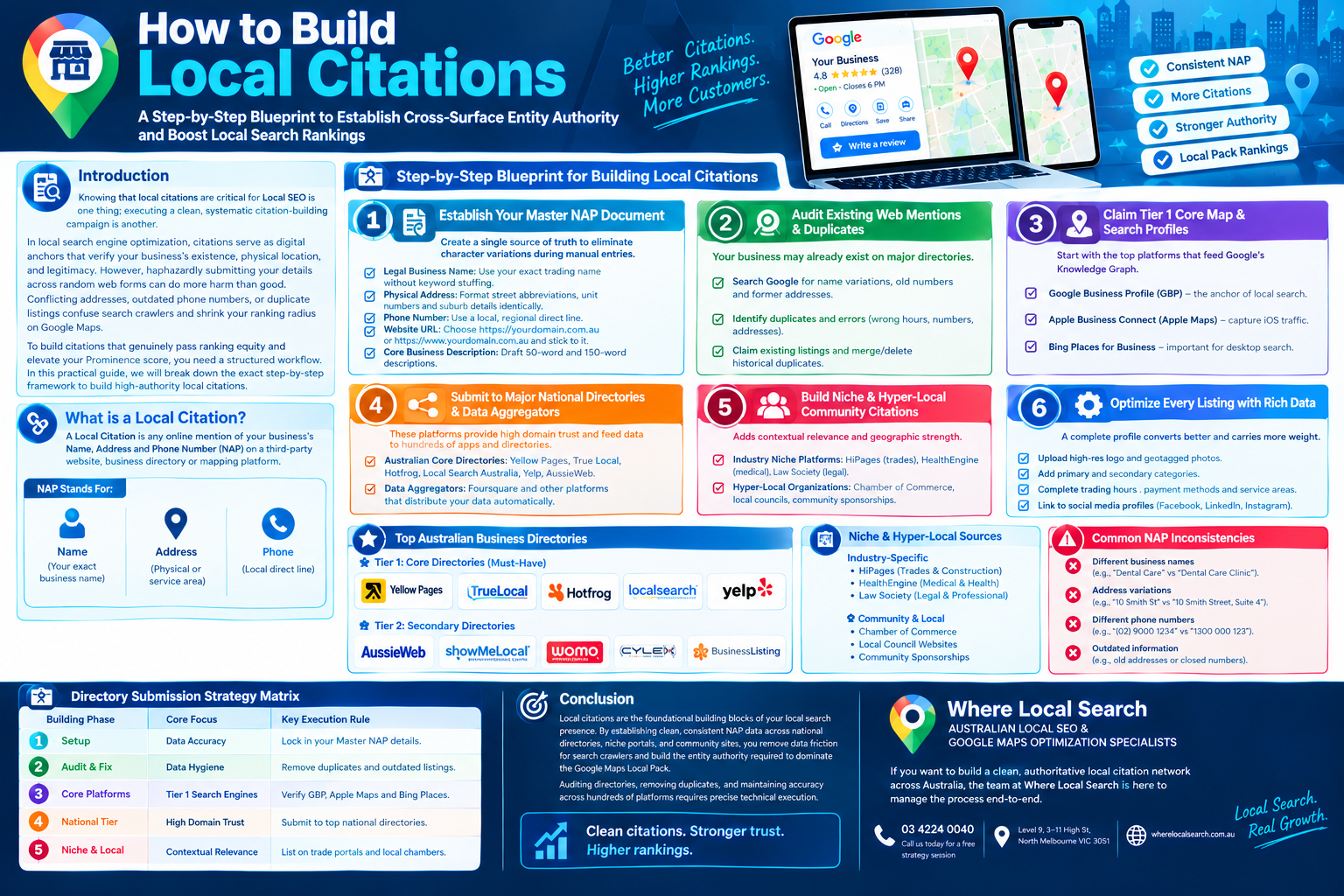
A Step-by-Step Blueprint to Establish Cross-Surface Entity Authority and Boost Local Search Rankings
Knowing that local citations are critical for Local SEO is one thing; executing a clean, systematic citation-building campaign is another.
In local search engine optimization, citations serve as digital anchors that verify your business’s existence, physical location, and legitimacy. However, haphazardly submitting your details across random web forms can do more harm than good. Conflicting addresses, outdated phone numbers, or duplicate listings confuse search crawlers and shrink your ranking radius on Google Maps.
To build citations that genuinely pass ranking equity and elevate your Prominence score, you need a structured workflow. In this practical guide, we will break down the exact step-by-step framework to build high-authority local citations.
Step-by-Step Blueprint for Building Local Citations
Step 1: Establish Your Master NAP Document
Before submitting your details to a single directory, create a single source of truth—a Master Business Identity Document. This eliminates character variations during manual entries:
☑ Legal Business Name: Write your exact trading name without keyword stuffing.
☑ Physical Address: Format street abbreviations, unit numbers, and suburban details identically.
☑ Phone Number: Use a local, regional direct line (e.g., landline with regional area code).
☑ Website URL: Decide between https://yourdomain.com.au or https://www.yourdomain.com.au and stick to it strictly.
☑ Core Business Description: Draft standardized short (50-word) and long (150-word) business descriptions.
Step 2: Audit Existing Web Mentions & Duplicates
Your business may already exist on major directories via automated data scrapers:
- Perform a Manual Audit: Search Google using variations of your business name, past phone numbers, and former addresses (e.g., "Your Business Name" + "City").
- Identify Duplicates & Errors: Document any existing listings that feature wrong opening hours, old phone numbers, or incorrect addresses.
- Prioritize Cleanup: Claim ownership of existing listings and fix errors before submitting new directory applications.
Step 3: Claim Tier 1 Core Map & Search Profiles
Start at the top of the search ecosystem. These primary platforms pass the highest level of trust directly to Google's local Knowledge Graph:
- Google Business Profile (GBP): The anchor of all local search activity.
- Apple Business Connect (Apple Maps): Critical for capturing iOS Siri and Apple Maps traffic.
- Bing Places for Business: Important for desktop search default traffic.
Step 4: Submit to Major National Directories & Data Aggregators
Once Tier 1 profiles are live, move to national business directories that search engines use for cross-verification:
- Australian Core Directories: Yellow Pages Australia, True Local, Hotfrog, Local Search Australia, Yelp, and AussieWeb.
- Submit to Data Aggregators: Platforms like Foursquare feed business details to hundreds of downstream mobile apps, vehicle GPS systems, and local directories automatically.
Step 5: Build Niche & Hyper-Local Community Citations
General directories establish baseline authority, but Niche and Local citations provide deep contextual relevance:
- Industry Niche Platforms: Submit your business to specialized trade portals (e.g., HiPages for trades, HealthEngine for medical, Law Society directories for legal practitioners).
- Hyper-Local Organizations: Secure mentions on your regional Chamber of Commerce website, local business awards registers, and community sponsorship pages.
Step 6: Optimize Every Listing with Rich Data
A citation with just a phone number and address is a missed opportunity. Fully completed profiles convert better and carry higher algorithmic weight:
☑ Upload high-resolution logo files and geotagged team/storefront photos.
☑ Add primary and secondary business categories that match your Google profile.
☑ Complete trading hours, accepted payment methods, and service area radiuses.
☑ Add direct social media profile links (Facebook, LinkedIn, Instagram).
Citation Building Execution Matrix
| Building Phase | Core Focus | Key Execution Rule |
|---|---|---|
| Phase 1: Standardization | Data Accuracy | Lock in your exact Master NAP details character-for-character. |
| Phase 2: Audit & Fix | Data Hygiene | Claim existing listings and merge/delete historical duplicates. |
| Phase 3: Core Platforms | Tier 1 Search Engines | Fully verify Google Business Profile, Apple Maps, and Bing Places. |
| Phase 4: National Tier | High Domain Trust | Submit to top national Australian directories (Yellow Pages, True Local). |
| Phase 5: Niche & Local | Contextual Relevance | Secure listings on trade associations and local Chamber of Commerce portals. |
Conclusion
Building local citations is a foundational pillar of Local SEO that establishes entity trust, validates physical location data, and powers your Google Maps rankings. By maintaining absolute NAP consistency, auditing existing web mentions, and strategically building out national, niche, and hyper-local directory listings, you create an unbeatable data footprint that search crawlers reward.
Standardizing data across hundreds of directories, fixing historical web duplicates, and maintaining ongoing citation hygiene requires systematic, ongoing execution.
If you want to build a clean, authoritative local citation network across Australia, the expert team at Where Local Search is here to manage the process end-to-end. As premier specialists in Australian Local SEO and Google Maps optimization, we build structured systems that turn digital entity trust directly into long-term commercial growth.