
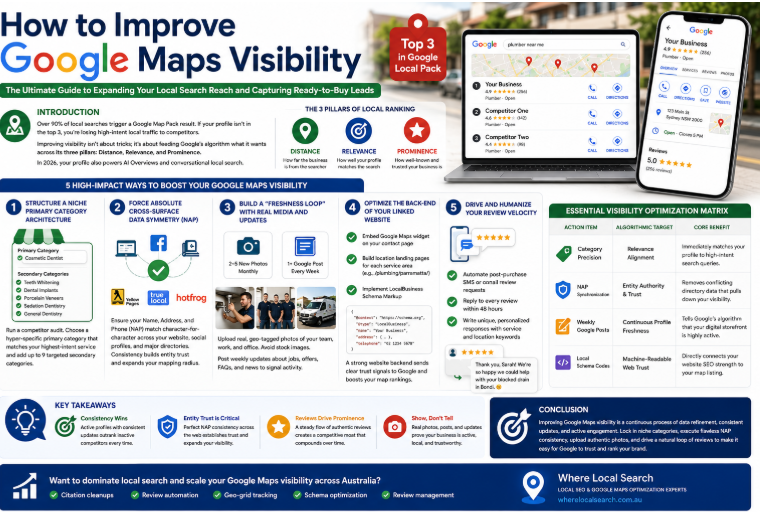
The Ultimate Guide to Expanding Your Local Search Reach and Capturing Ready-to-Buy Leads
Simply having a verified Google Business Profile (GBP) is no longer enough to win the local search game. With over 90% of local searches triggering a Google Map Pack result, your business needs high visibility to survive. If your profile isn’t appearing in the top 3 positions, you are losing massive amounts of high-intent local traffic to your closest competitors.
Improving your Google Maps visibility isn't about trying to trick the system; it is about systematically feeding Google's algorithm exactly what it wants across its three core ranking pillars: Distance, Relevance, and Prominence. In 2026, your profile is also the primary data source driving AI Overviews and conversational local search tools.
In this comprehensive guide, we will break down the proven tactical steps required to drastically improve your Google Maps visibility and turn search impressions into actual paying clients.
5 High-Impact Ways to Boost Your Google Maps Visibility
1. Structure a Niche Primary Category Architecture
Your business category is the most powerful relevance tool you control. If you choose a category that is too broad, your profile gets lost in a sea of generic competitors.
💡 The Strategy: Run a competitor audit using local tools to see what categories the top 3 Local Pack leaders are using. Switch your Primary Category to a hyper-specific option that exactly matches your highest-intent service (e.g., choosing "Cosmetic Dentist" instead of just "Dentist"). Add up to 9 highly targeted secondary categories to cover your secondary services.
2. Force Absolute Cross-Surface Data Symmetry (NAP)
Google requires definitive proof that your business is a stable, legitimate, and trusted local entity before it rewards you with high search visibility.
💡 The Strategy: Conduct a thorough citation audit across the web. Ensure your Name, Address, and Phone number (NAP) details match character-for-character across your website footer, social media networks, and major national business directories like Yellow Pages Australia, True Local, and Hotfrog. Data inconsistencies confuse search engine crawlers and pull back your mapping radius.
3. Build a "Freshness Loop" with Real Media and Updates
Google rewards active profiles because engagement signals that your business is operating and trustworthy. Inactivity acts as a silent penalty that drains your reach.
💡 The Strategy: Maintain a strict monthly upload schedule, adding 2 to 5 fresh smartphone-shot images showing real team members, live jobs, or real office walk-throughs. Strictly avoid using generic internet stock photos, as Google's image-recognition AI easily flags and auto-rejects them. Additionally, publish at least one high-quality update using Google Posts every week to maintain steady visibility signals.
4. Optimize the Back-End of Your Linked Website
Your website's overall organic search engine optimization strength heavily dictates your Google Maps ranking success.
💡 The Strategy: Embed your official Google Maps interactive widget directly on your contact page. If you serve multiple geographic zones, build unique, dedicated location landing pages (e.g., /plumbing/parramatta/). Deploy structured LocalBusiness Schema Markup code on the backend of your site to serve clean data straight to search engines.
5. Drive and Humanize Your Review Velocity
The absolute volume, recency, and quality of your reviews are major prominence ranking factors.
💡 The Strategy: Implement an automated workflow via post-purchase SMS or email to request feedback immediately following a successful sale. Proactively reply to every single review within 48 hours. Avoid copy-pasting generic template replies; write unique, personalized responses that naturally incorporate your secondary service keywords and locations where it makes sense.
Essential Visibility Optimization Matrix
| Action Item | Algorithmic Target | Core Benefit |
|---|---|---|
| Category Precision | Relevance Alignment | Immediately matches your profile to high-intent search queries. |
| NAP Synchronization | Entity Authority & Trust | Removes conflicting directory data that pulls down your visibility. |
| Weekly Google Posts | Continuous Profile Freshness | Tells Google's algorithm that your digital storefront is highly active. |
| Local Schema Codes | Machine-Readable Web Trust | Directly connects your website SEO strength to your map listing. |
Conclusion
Improving your Google Maps visibility is a continuous process of data refinement, consistent media updates, and active customer engagement. By locking in niche categories, executing flawless cross-surface data symmetry, uploading authentic photos, and driving a natural loop of customer reviews, you make it incredibly easy for Google's algorithm to trust and surface your brand.
Running deep citation cleanups, monitoring complex web schemas, analyzing competitor shifts across geo-grids, and managing daily review interactions takes consistent technical execution beside running your company.
If you want to ensure your business safely dominates local search and dramatically scales its Google Maps visibility across Australia, the expert team at Where Local Search is here to deliver. As leading specialists in Local SEO and Google Maps optimization, we build comprehensive, data-driven systems that securely convert map impressions directly into sustainable commercial revenue.