
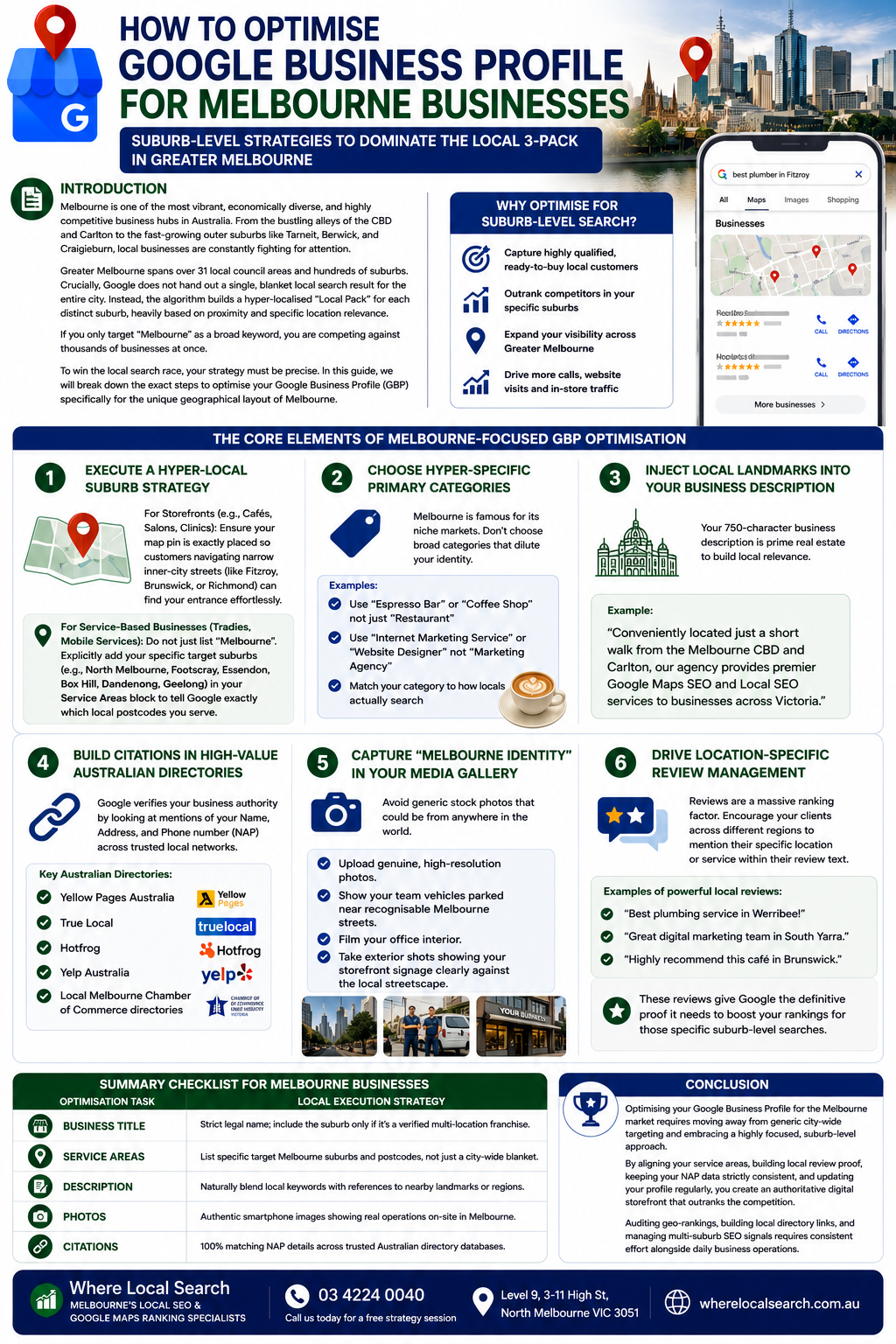
Suburb-Level Strategies to Dominate the Local 3-Pack in Greater Melbourne
Melbourne is one of the most vibrant, economically diverse, and highly competitive business hubs in Australia. From the bustling alleys of the CBD and Carlton to the fast-growing outer suburbs like Tarneit, Berwick, and Craigieburn, local businesses are constantly fighting for attention.
Greater Melbourne spans over 31 local council areas and hundreds of suburbs. Crucially, Google does not hand out a single, blanket local search result for the entire city. Instead, the algorithm builds a hyper-localised "Local Pack" for each distinct suburb, heavily based on proximity and specific location relevance. If you only target "Melbourne" as a broad keyword, you are competing against thousands of businesses at once.
To win the local search race, your strategy must be precise. In this guide, we will break down the exact steps to optimise your Google Business Profile (GBP) specifically for the unique geographical layout of Melbourne.
The Core Elements of Melbourne-Focused GBP Optimisation
1. Execute a Hyper-Local Suburb Strategy
Because Greater Melbourne is so vast, your profile must reflect the exact service areas or physical location you cover.
- For Storefronts (e.g., Cafés, Salons, Clinics): Ensure your map pin is exactly placed so customers navigating narrow inner-city streets (like Fitzroy, Brunswick, or Richmond) can find your entrance effortlessly.
- For Service-Based Businesses (Tradies, Mobile Services): Do not just list "Melbourne". Explicitly add your specific target suburbs (e.g., North Melbourne, Footscray, Essendon, Box Hill, Dandenong, Geelong) in your Service Areas block to tell Google exactly which local postcodes you serve.
2. Choose Hyper-Specific Primary Categories
Melbourne is famous for its niche markets. Don't choose broad categories that dilute your identity.
- If you operate a specialized coffee house in the heart of Melbourne's coffee culture, select "Espresso Bar" or "Coffee Shop" rather than a generic "Restaurant" option.
- If you provide digital services, select "Internet Marketing Service" or "Website Designer" to align directly with specific B2B local searches.
3. Inject Local Landmarks into Your Business Description
Your 750-character business description is prime real estate to build local relevance. Write a natural description that references your proximity to recognizable Melbourne landmarks, major roads, or regional hubs.
Example: "Conveniently located just a short walk from the Melbourne CBD and Carlton, our agency provides premier Google Maps SEO and Local SEO services to businesses across Victoria."
4. Build Citations in High-Value Australian Directories
Google verifies your business authority by looking at mentions of your Name, Address, and Phone number (NAP) across trusted local networks. Ensure matching records across key domestic directories:
5. Capture "Melbourne Identity" in Your Media Gallery
Avoid using generic stock photos that could be from anywhere in the world. Upload genuine, high-resolution shots that anchor your business in its actual environment. Show your team vehicles parked near recognisable Melbourne streets, film your office interior, and take exterior shots showing your storefront signage clearly against the local streetscape.
6. Drive Location-Specific Review Management
Reviews are a massive ranking factor. Encourage your clients across different regions to mention their specific location or service within their review text. A review stating, "Best plumbing service in Werribee," or "Great digital marketing team in South Yarra," gives Google the definitive proof it needs to boost your rankings for those specific suburb-level search queries.
Summary Checklist for Melbourne Businesses
| Optimisation Task | Local Execution Strategy |
|---|---|
| Business Title | Strict legal name; include the suburb only if it's a verified multi-location franchise. |
| Service Areas | List specific target Melbourne suburbs and postcodes, not just a city-wide blanket. |
| Description | Naturally blend local keywords with references to nearby landmarks or regions. |
| Photos | Authentic smartphone images showing real operations on-site in Melbourne. |
| Citations | 100% matching NAP details across trusted Australian directory databases. |
Conclusion
Optimising your Google Business Profile for the Melbourne market requires moving away from generic city-wide targeting and embracing a highly focused, suburb-level approach. By aligning your service areas, building local review proof, keeping your NAP data strictly consistent, and updating your profile regularly, you create an authoritative digital storefront that outranks the competition.
Auditing geo-rankings, building local directory links, and managing multi-suburb SEO signals requires consistent effort alongside daily business operations.
If you want to fast-track your path to the top of the Google Maps 3-Pack and capture highly qualified local leads across Victoria, Where Local Search is here to deliver results. As a Melbourne-based Local SEO and Google Maps Ranking specialist agency, we design data-driven strategies that put your business front and center where local buyers are looking. Contact Where Local Search today to unlock sustainable online growth.