
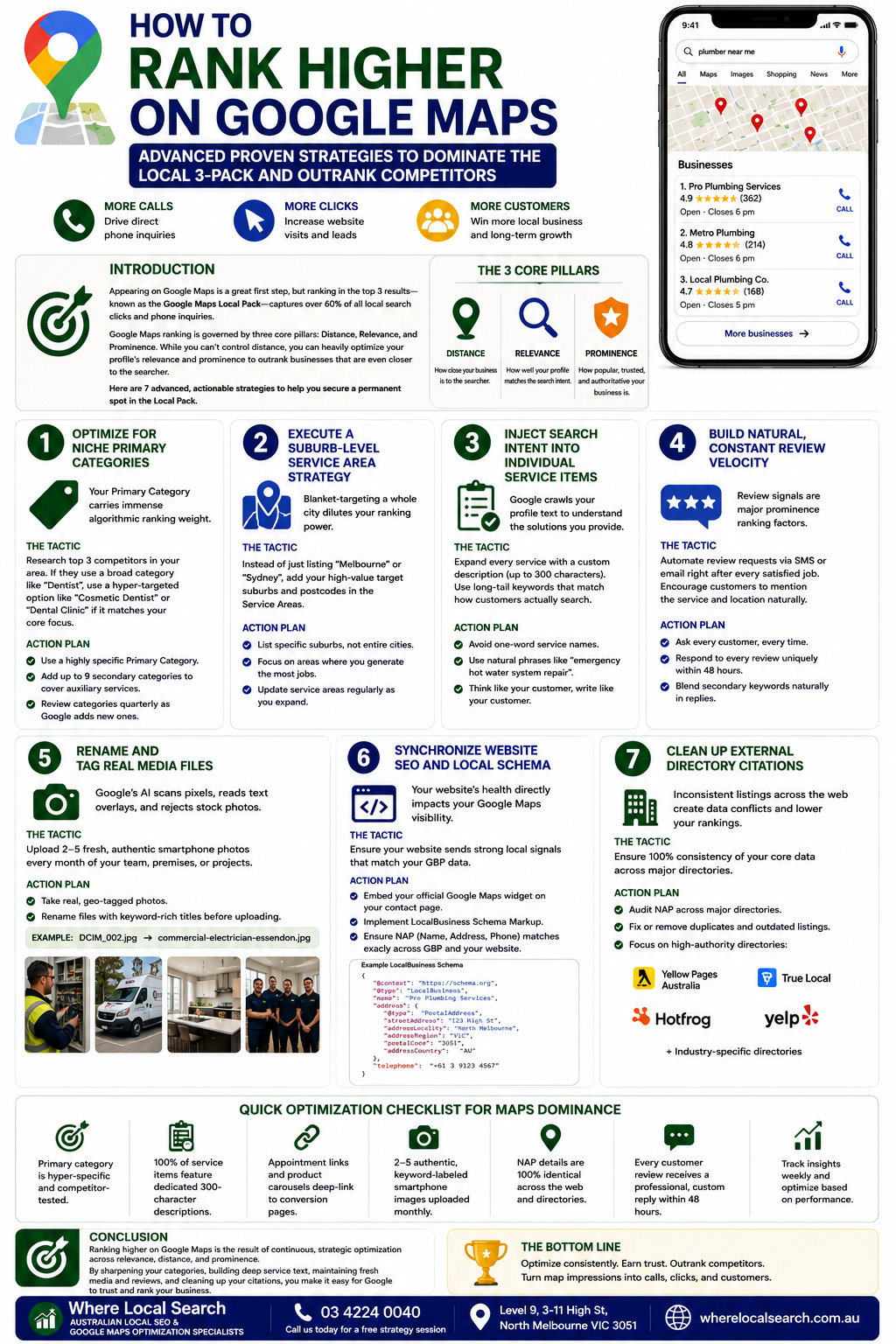
Advanced Proven Strategies to Dominate the Local 3-Pack and Outrank Competitors
Appearing on Google Maps is a great first step, but the real commercial value lies in ranking in the top 3 results—known as the Google Maps Local Pack. Statistics show that the top three listings capture over 60% of all local search clicks and phone inquiries, leaving the businesses buried on page two with little to no organic traffic.
Google Maps ranking isn't driven by luck or corporate budget; it is governed by a specific local algorithm built around three core pillars: Distance, Relevance, and Prominence. While you cannot control a user's real-time physical distance, you can heavily optimize your profile's relevance and prominence to outrank businesses that are physically closer to the searcher than you are.
In this guide, we will dive into advanced, actionable strategies to help your business outrank local competitors and secure a permanent spot in the Local Pack.
7 Advanced Strategies to Rank Higher on Google Maps
1. Optimize for Niche Primary Categories
Your Primary Category carries immense algorithmic ranking weight. A common pitfall is choosing a generic category that creates too much broad competition.
💡 The Tactic: Research the top 3 ranking competitors in your specific neighborhood using tools like GMB Everywhere. If they are all using a broad category like "Dentist", and your core focus is specific, switching to a hyper-targeted primary category like "Cosmetic Dentist" or "Dental Clinic" can give you an immediate algorithmic advantage. Add up to 9 secondary categories to cover your remaining auxiliary services.
2. Execute a Suburb-Level Service Area Strategy
If you operate a service-based business without a physical storefront (like a plumber, electrician, or digital agency), blanket-targeting an entire massive city will dilute your ranking power.
💡 The Tactic: Instead of just listing "Melbourne" or "Sydney", explicitly log your high-value target suburbs and local postcodes within the Service Areas tab in your dashboard. This builds clear regional relevance signals, helping you win distinct suburb-level search grids.
3. Inject Search Intent into Individual Service Items
Google crawls your profile's custom text fields to understand exactly what solutions you provide to buyers.
💡 The Tactic: Do not just add simple, one-word service names. Expand every single service item by writing a custom description (up to 300 characters). Naturally blend in long-tail keywords that match conversational search intent (e.g., using terms like "emergency hot water system repair" instead of just "plumbing").
4. Build Natural, Constant Review Velocity
Review signals—including star rating, review volume, and review recency—are major prominence ranking factors.
💡 The Tactic: Implement an automated system (via post-sale SMS or email) to ask every single satisfied customer for an honest review immediately following a job. Gently prompt them to mention the specific service they received and their general location naturally in the text. Always respond uniquely to every review, blending in your secondary service keywords naturally within your reply.
5. Rename and Tag Real Media Files
Google’s image-recognition AI is highly advanced; it scans pixels, reads text overlays, and explicitly rejects standard internet stock photography.
💡 The Tactic: Maintain an active upload cadence, adding 2 to 5 fresh, authentic smartphone photos of your team, premises, or completed projects every month. Before uploading, rename raw camera file names (like DCIM_002.jpg) into clean, keyword-optimized titles (e.g., commercial-electrician-essendon.jpg).
6. Synchronize Website SEO and Local Schema
Your website’s health directly impacts your Google Maps visibility. Google continuously crawls your linked website to cross-verify the data on your GBP.
💡 The Tactic: Embed your official Google Maps widget directly on your contact page. Ensure you deploy structured LocalBusiness Schema Markup code on your site's backend, making sure your Name, Address, and Phone number (NAP) data matches your business profile down to the exact letter.
7. Clean Up External Directory Citations
Inconsistent business listings across the web create data conflicts, which damages Google's algorithmic trust and lowers your map rankings.
💡 The Tactic: Conduct a comprehensive local citation audit. Ensure your core business data is 100% consistent across major national directories like Yellow Pages Australia, True Local, Hotfrog, and Yelp. Eliminate or fix any duplicate listings or outdated phone numbers immediately.
Quick Optimization Checklist for Maps Dominance
☑ Primary category is hyper-specific and competitor-tested.
☑ 100% of service items feature dedicated 300-character descriptions.
☑ Appointment links and product carousels deep-link to conversion pages.
☑ 2 to 5 authentic, keyword-labeled smartphone images uploaded monthly.
☑ NAP details are 100% identical across the web and local business directories.
☑ Every single customer review receives a professional, custom reply within 48 hours.
Conclusion
Ranking higher on Google Maps is the result of continuous, strategic optimization across relevance, distance, and prominence. By sharpening your primary category selection, building deep service text signals, maintaining a steady monthly stream of real photo uploads, and cleaning up your external web citations, you make it incredibly easy for the algorithm to trust and rank your storefront.
Consistently running local citation cleanups, tracking changing local search grids, monitoring competitor category shifts, and managing data parameters requires ongoing technical execution alongside running your daily business operations.
If you want to ensure your business safely dominates the Google Maps Local Pack across Australia, the expert team at Where Local Search is here to manage the process end-to-end. As premier specialists in Local SEO and Google Maps Ranking, we design custom, data-driven strategies that optimize your entire online presence, turning map discovery into long-term commercial revenue.