
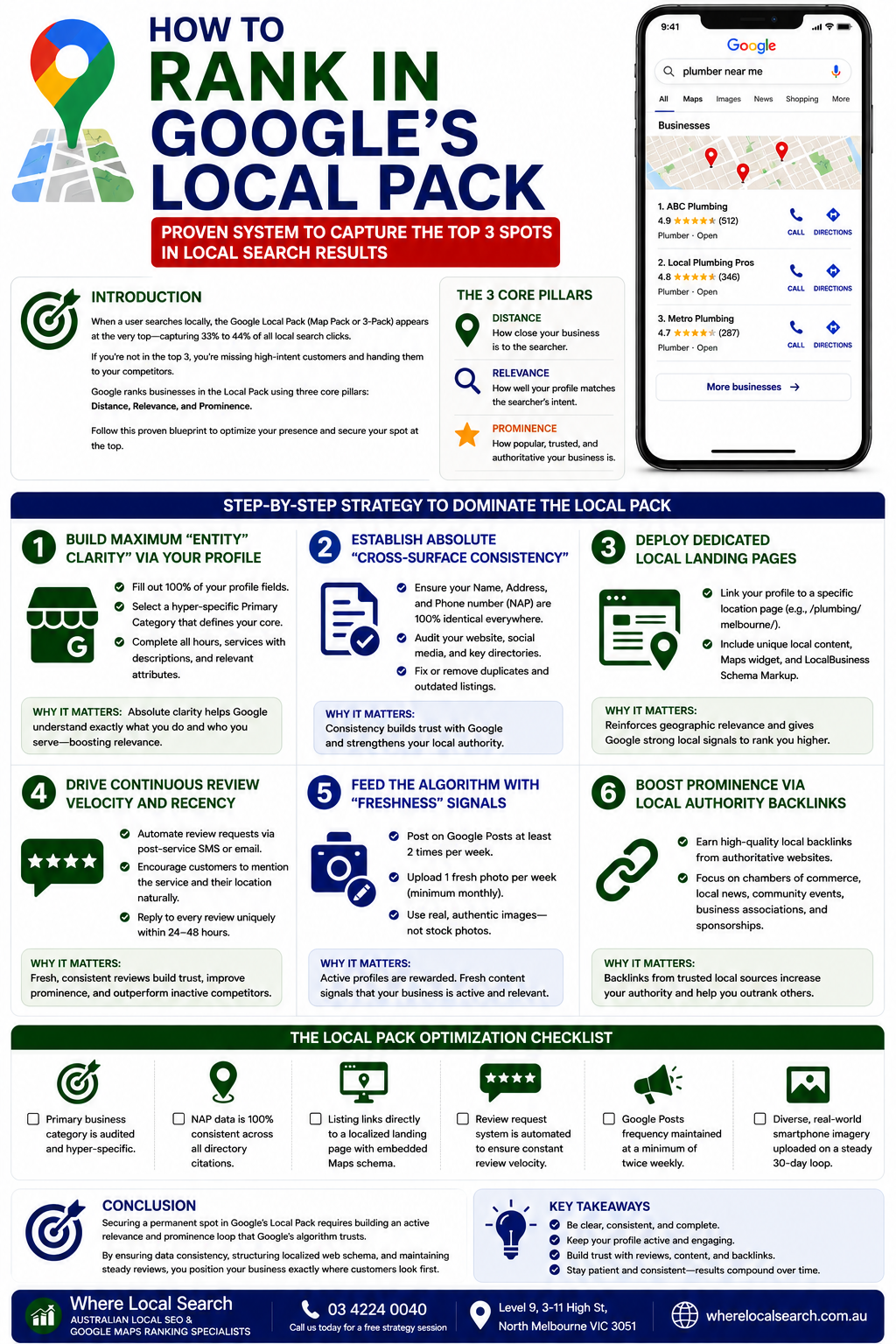
Proven System to Capture the Top 3 Spots in Local Search Results
When a user searches for a local service or business, Google doesn't just display a list of standard blue website links. At the very top of the page, it features the Google Local Pack (also known as the Map Pack or 3-Pack)—a highly prominent block containing a map layout and the top three local business listings.
Studies show that the Local Pack captures between 33% and 44% of all local search clicks, heavily outperforming the organic listings situated below them. If your business does not claim one of these top three positions, you are essentially handing ready-to-buy local customers directly to your competitors.
Winning a spot in the Local Pack requires understanding how Google scores businesses using its three core algorithm pillars: Distance, Relevance, and Prominence. In this guide, we will map out a concrete blueprint to help you optimize your entire online presence and secure your spot at the top.
Step-by-Step Strategy to Dominate the Local Pack
1. Build Maximum "Entity Clarity" via Your Profile
Your Google Business Profile (GBP) is the absolute foundation of your Local Pack eligibility. Google's systems must completely trust what your business identity is before it gives you a top rank.
💡 Action: Fill out 100% of your profile fields. Select a hyper-specific Primary Category that exactly defines your core operations (e.g., choose "Emergency Plumber" instead of just "Plumber" if that is your primary high-intent focus). Complete all operational hours, list custom services with text descriptions, and tick off all relevant structural attributes.
2. Establish Absolute "Cross-Surface Consistency"
Google cross-references your business data across the entire web to ensure your entity is stable and legitimate.
💡 Action: Conduct a comprehensive cleanup of your Name, Address, and Phone number (NAP) data. Your NAP details must be 100% identical—character for character—across your Google listing, your website footer, your social media accounts, and trusted national business directories like Yellow Pages Australia, Hotfrog, and True Local.
3. Deploy Dedicated Local Landing Pages
Where you link your profile matters significantly. Linking an optimized profile to a broad, generic website homepage can confuse the local algorithm regarding your specific geographic focus.
💡 Action: If you serve a specific city or multiple geographic regions, build dedicated, optimized location pages (e.g., /plumbing/melbourne/). Link your profile directly to this location page. Ensure the page features unique localized content, an embedded Google Maps widget, and hardcoded LocalBusiness Schema Markup code in the backend to feed clean data to Google's crawlers.
4. Drive Continuous Review Velocity and Recency
Review signals carry immense weight in Local Pack algorithms. Google doesn't just look at a high star rating; it heavily evaluates review velocity (how consistently reviews arrive) and recency (how fresh they are).
💡 Action: Set up a clean, automated loop via post-service SMS or email to request honest feedback right after a transaction. Gently encourage customers to naturally mention the specific service they received and their neighborhood location in their text. Always respond to every review uniquely within 24–48 hours to signal active profile management.
5. Feed the Algorithm with "Freshness" Signals
Dormant profiles gradually slide down the ranking ladder as active competitors continuously update their listings.
💡 Action: Post a minimum of 2 times per week using the Google Posts feature to showcase updates, seasonal offers, and service breakthroughs. Additionally, upload 1 fresh photo per week (or a minimum of one monthly). Avoid generic stock photos; use real smartphone images showing real operations on the ground to build algorithmic trust.
6. Boost Prominence via Local Authority Backlinks
Prominence is heavily driven by traditional search engine optimization principles applied to a local market.
💡 Action: Earn high-quality, localized backlinks from external authoritative sites within your geographic area. Focus on securing links from your local Chamber of Commerce, neighborhood business associations, community event sponsorships, or local media editorial roundups.
The Local Pack Optimization Checklist
☑ Primary business category is audited and hyper-specific.
☑ NAP data is 100% consistent across all directory citations.
☑ Listing links directly to a localized landing page with embedded Maps schema.
☑ Review request system is automated to ensure constant review velocity.
☑ Google Posts frequency maintained at a minimum of twice weekly.
☑ Diverse, real-world smartphone imagery uploaded on a steady 30-day loop.
Conclusion
Securing a permanent spot in Google's Local Pack is not a one-time setup task; it is the direct result of building an active relevance and prominence loop that Google's algorithm completely trusts. By ensuring absolute data consistency across surfaces, structuring localized web schema, and maintaining a healthy flow of customer reviews, you position your digital storefront exactly where active buyers look first.
Managing hyper-local schema structures, running constant citation audits, monitoring shifting competitor categories, and driving review velocity requires consistent technical execution alongside running your day-to-day operations.
If you want to fast-track your path into the top 3 Local Pack and scale your local search visibility safely, the team at Where Local Search is ready to manage the process end-to-end. As specialized experts in Australian Local SEO and Google Maps ranking, we execute tailored, data-driven systems that transform search visibility directly into commercial revenue.