
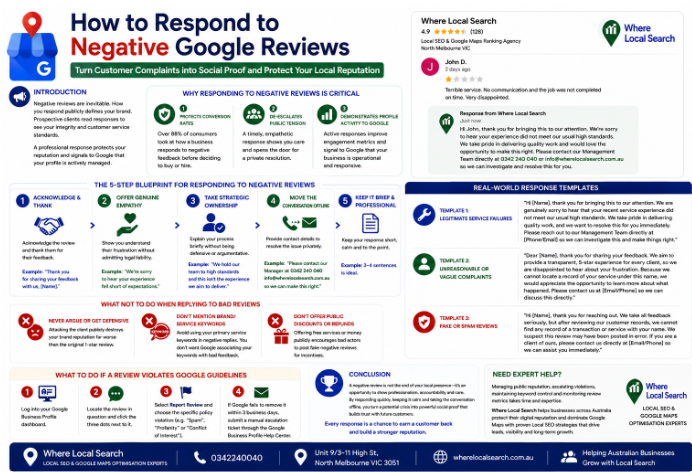
Turn Customer Complaints into Social Proof and Protect Your Local Reputation
Every business owner dreads the notification of a 1-star or 2-star Google review. A negative review feels personal, and it’s natural to feel defensive—especially if the customer’s claim seems unfair or inaccurate.
However, negative reviews are an inevitable part of running a growing business. What truly defines your brand is not the negative feedback itself, but how you respond to it publicly. Prospective clients heavily read negative review responses to gauge your integrity, accountability, and customer service standards.
Moreover, responding to negative reviews professionally helps protect your Local SEO prominence score by signaling to Google’s algorithm that your profile is actively managed and dedicated to customer resolution. In this guide, we will outline a strategic, step-by-step blueprint for responding to negative Google reviews without damaging your brand.
Why Responding to Negative Reviews is Critical
1. Protects Conversion Rates with Prospective Clients
Over 88% of consumers look at how a business owner responds to negative feedback before deciding whether to hire them or buy from them. A calm, solution-oriented response transforms a potential red flag into proof that you take customer satisfaction seriously.
2. De-Escalates Public Tension
Ignoring a negative review sends a message to both the reviewer and the public that you do not care. A swift, empathetic response halts public hostility and opens the door for a private resolution.
3. Demonstrates Profile Activity to Google
Google evaluates operational responsiveness across all review types. Leaving 1-star reviews unaddressed lowers your engagement metrics, while actively resolving issues shows search engines that your storefront remains active and operational.
The 5-Step Blueprint for Responding to Negative Reviews
Start professionally without being overly apologetic for unfounded claims (e.g., "Thank you for sharing your feedback with us, [Name].").
Validate their frustration without admitting legal liability (e.g., "We hold our team to high standards, and we are sorry to hear that your experience fell short of expectations.").
Briefly state what usually happens in your operations without sounding defensive or argumentative.
Never debate back and forth in a public comment section. Provide a direct contact phone number or email address for a manager (e.g., "We would love the chance to make this right. Please contact our General Manager directly at [Email/Phone].").
Long, defensive essays draw more attention to the issue. A short, professional 3-to-4-sentence response is ideal.
Real-World Response Templates
Template 1: For Legitimate Service Failures
"Hi [Name], thank you for bringing this to our attention. We are genuinely sorry to hear that your recent service experience did not meet our usual high standards. We take pride in delivering quality work, and we want to resolve this for you immediately. Please reach out to our Management Team directly at [Phone/Email] so we can investigate this and make things right."
Template 2: For Unreasonable or Vague Complaints
"Dear [Name], thank you for sharing your feedback. We aim to provide a transparent, 5-star experience for every client, so we are disappointed to hear about your frustration. Because we cannot locate a record of your service under this name, we would appreciate the opportunity to learn more about what happened. Please contact us at [Email/Phone] so we can discuss this directly."
Template 3: For Fake or Spam Reviews
"Hi [Name], thank you for reaching out. We take all feedback seriously, but after reviewing our customer records, we cannot find any record of a transaction or service with your name. We suspect this review may have been posted in error. If you are a client of ours, please contact us directly at [Email/Phone] so we can assist you immediately."
What NOT to Do When Replying to Bad Reviews
Attacking the client publicly destroys your brand reputation far worse than the original 1-star review itself.
Avoid using your primary service keywords (e.g., "emergency plumbing Parramatta") in negative review replies, as you do not want Google associating your core SEO keywords with bad feedback.
Offering free services or money publicly encourages bad actors to post fake negative reviews just to get free incentives.
What to Do If a Review Violates Google Guidelines
If a negative review contains offensive language, hate speech, clear conflict of interest, or fake spam, you do not have to leave it sitting on your profile indefinitely:
1. Log In: Log into your Google Business Profile dashboard.
2. Locate the Review: Find the review in question and click the three dots icon next to it.
3. Report Violation: Select "Report Review" and choose the specific policy violation (e.g., "Spam", "Profanity", or "Conflict of Interest").
4. Escalate if Needed: If Google fails to remove it within 3 business days, submit a manual escalation ticket through the Google Business Profile Help Center.
Conclusion
A negative Google review is not the end of your local search presence—it is a public platform to demonstrate your professionalism, accountability, and commitment to customer care. By applying a structured, unemotional response strategy and taking disputes offline quickly, you turn a potential crisis into powerful social proof that builds trust with prospective clients.
Managing public reputation streams, escalating policy violations to Google, maintaining keyword control, and monitoring review metrics requires careful, consistent operational focus.
If you want to protect your digital reputation, handle complex review workflows, and securely build Local SEO authority across Australia, the expert team at Where Local Search is here to manage it end-to-end. As premier specialists in Local SEO and Google Maps optimization, we build data-driven systems that protect and scale your commercial footprint.