
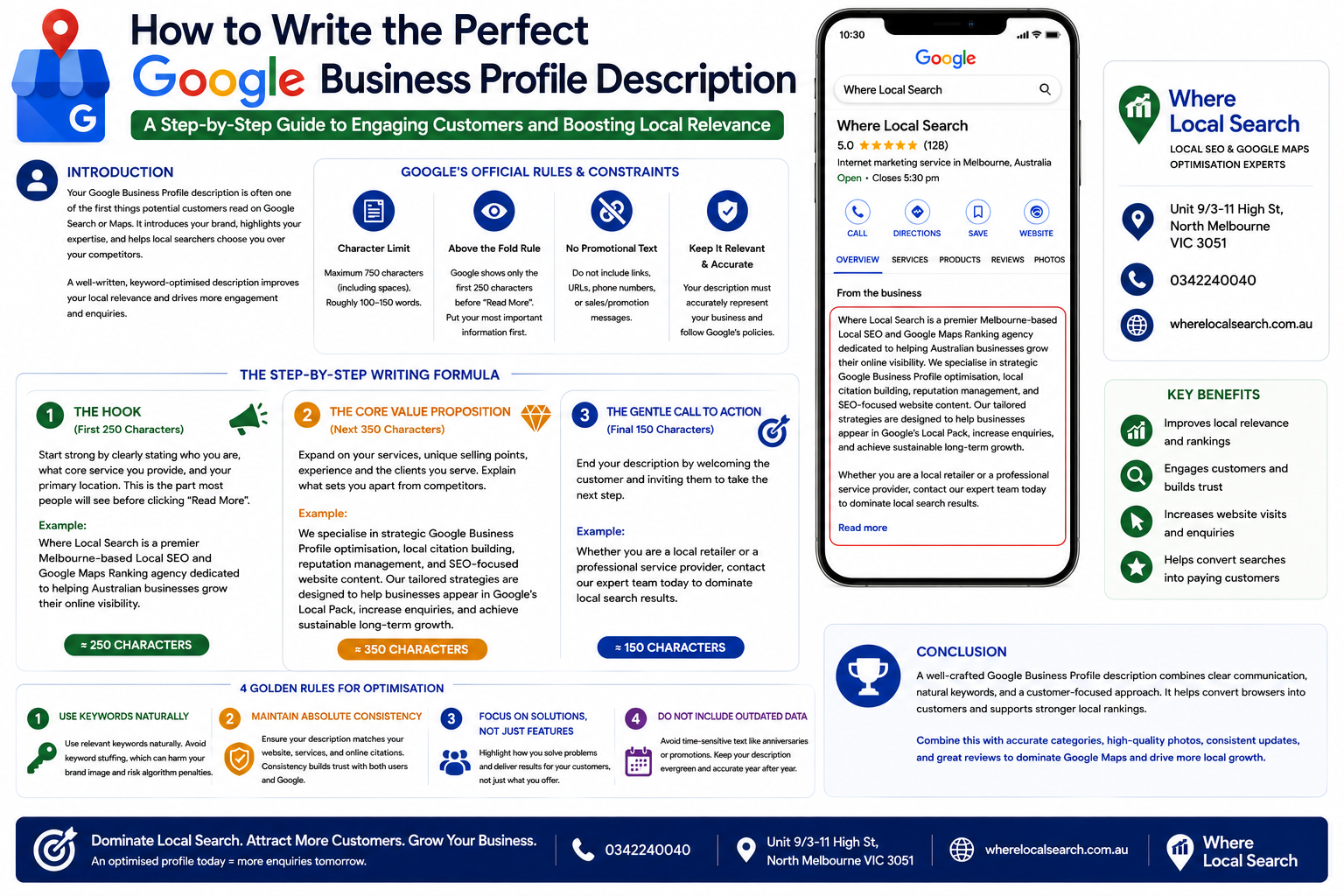
A Step-by-Step Guide to Engaging Customers and Boosting Local Relevance
When potential customers discover your business on Google Search or Google Maps, your Google Business Profile (GBP) description is often one of the very first things they read. It acts as your digital elevator pitch—a brief, powerful statement that introduces your brand, highlights your expertise, and convinces local searchers to choose you over the competition.
While your business category and location tell Google where and what you are, your business description tells customers why you matter. Writing a compelling, keyword-optimised description is a highly effective way to improve your local relevance and increase customer engagement.
In this guide, we will break down Google's formatting rules, explore a step-by-step formula for writing the perfect description, and cover the critical mistakes you must avoid.
Google’s Official Rules and Constraints
Before you start writing, it is essential to understand the technical boundaries set by Google's guidelines to ensure your description gets approved without any issues:
Google allows a maximum of 750 characters (including spaces). This is roughly 100 to 150 words.
Google often truncates text, showing only the first 250 characters before adding a "Read More" link. Put critical info first.
Strictly avoid links, URLs, phone numbers, or promotional slogans (e.g., "50% OFF TODAY!"). Save these for Google Posts.
The Step-by-Step Writing Formula
To make the most of your 750-character limit, follow this proven three-part structural formula:
1. The Hook (First 250 Characters)
Start strong by clearly stating exactly who you are, what core service you provide, and your primary location. This ensures that even if a user doesn't click "Read More," they instantly get the most vital context.
Example: "Where Local Search is a premier Melbourne-based Local SEO and Google Maps Ranking agency dedicated to helping Australian businesses grow their online visibility."
2. The Core Value Proposition (Next 350 Characters)
Use the middle section to expand on your specific services, your unique selling points (USP), and who you serve. Explain what sets you apart from your competitors. Mention experience, emergency availability, or unique offerings naturally here.
Example: "We specialise in strategic Google Business Profile optimisation, local citation building, reputation management, and SEO-focused website content. Our tailored strategies are designed to help businesses appear in Google’s Local Pack, increase enquiries, and achieve sustainable long-term growth."
3. The Gentle Call to Action (Final 150 Characters)
End your description by welcoming the customer and inviting them to take the next step, whether that is visiting your store, checking out your menu, or getting in touch for a quote.
Example: "Whether you are a local retailer or a professional service provider, contact our expert team today to dominate local search results."
4 Golden Rules for Optimisation
Integrating core target keywords helps Google understand relevance, but keyword stuffing hurts brand trust and risks algorithmic penalties. Keep it natural.
Ensure your tone, values, and services align with your website and online citations to build trust with search engines and users.
Customers seek local businesses to solve problems. Explain how you help them (e.g., "We quickly fix leaks to save you money" instead of just "Advanced diagnostic gear").
Do not use time-sensitive phrasing like "Celebrating our 5th anniversary this year!" Keep content evergreen so it stays accurate over time.
Conclusion
Writing the perfect Google Business Profile description requires a careful balance of clear communication, natural keyword usage, and a customer-focused approach. By placing your most important information upfront, highlighting your unique value, and avoiding forbidden promotional fluff, you build a digital storefront that converts casual browsers into paying customers.
Remember, your description is just one piece of a complete Local SEO strategy. To maintain dominant Google Maps rankings, it must be paired with accurate categories, high-quality photos, consistent updates, and a steady stream of customer reviews.
If you want to ensure your entire profile—from the description to your local citations—is perfectly optimised for maximum growth, the team at Where Local Search is here to guide you. As experts in Australian Local SEO, we create high-impact profiles that help local businesses dominate search results and attract more enquiries every single day.