
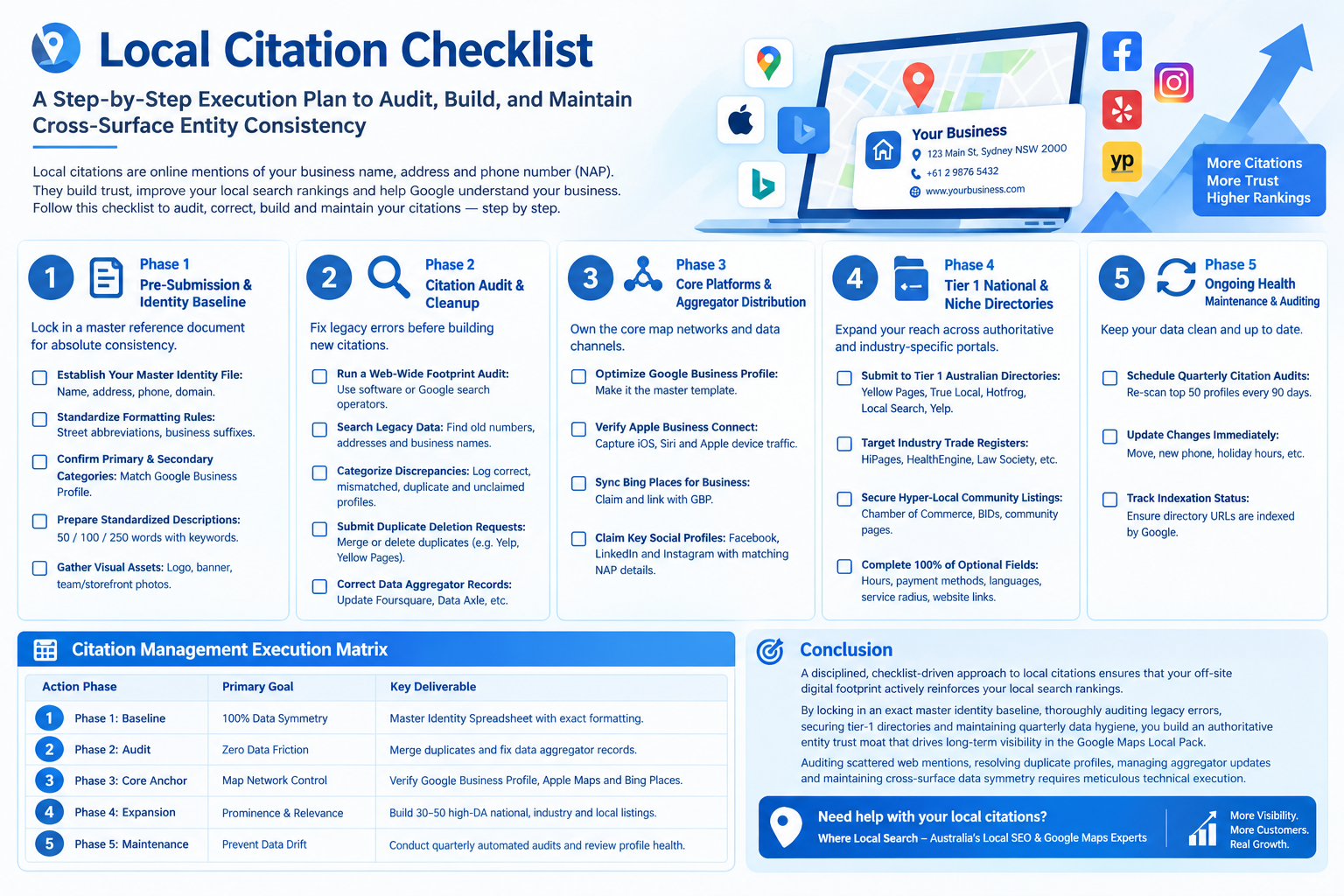
A Step-by-Step Execution Plan to Audit, Build, and Maintain Cross-Surface Entity Consistency
Building and managing local citations is one of the most effective ways to establish digital authority for your business. Every online directory, map platform, and local mention that contains your Name, Address, and Phone Number (NAP) serves as an independent trust signal to Google's local search algorithm.
However, citation building requires strict attention to detail. A single mismatched phone number, duplicate business profile, or un-audited historical address can create algorithmic confusion, diluting your entity trust score and shrinking your geographic ranking radius on Google Maps.
To ensure your citation ecosystem actively powers your Prominence pillar, you need a systematic operational workflow. This comprehensive Local Citation Checklist provides a clear, phase-by-phase action plan to audit, correct, build, and maintain your citations.
Phase 1: Pre-Submission & Identity Baseline
Before submitting your business details to a single directory, you must lock in an unalterable master reference document to guarantee absolute character-for-character consistency:
Document your exact legal business name, street address (including suite/unit numbers), direct local phone number, and primary domain URL in a central spreadsheet.
Decide on street abbreviations (e.g., "Street" vs. "St.") and business suffixes (e.g., including or excluding "Pty Ltd"), and enforce this exact text standard across all future entries.
Align your chosen business categories across platforms to match your primary category on Google Business Profile.
Write 50-word, 100-word, and 250-word business descriptions containing primary service and city keywords.
Prepare high-resolution PNG logos, cover banners, and geotagged storefront/team photos.
Phase 2: Citation Audit & Cleanup
Building new citations on top of legacy errors doubles your data confusion. You must audit and resolve historical discrepancies before expanding your directory footprint:
Use specialized citation audit software or targeted Google search operators to locate existing mentions of your business.
Perform manual searches for past phone numbers, former street addresses, and former business names to uncover un-indexed directory listings.
Log all active listings in an audit sheet, flagging correct entries, mismatched details, duplicate profiles, and unclaimed pages.
Request directory support teams to merge or delete duplicate profiles on platforms like Yelp or Yellow Pages to avoid splitting review authority.
Update core national data aggregators (e.g., Foursquare, Data Axle) to stop incorrect data from redistributing down to smaller directories.
Phase 3: Core Platforms & Aggregator Distribution
Establish ownership of the core map networks and data channels that feed third-party navigation tools, voice assistants, and search engines:
Ensure your GBP profile serves as the master template for all off-site citations.
Complete your Apple Maps profile to capture iOS, Siri, and Apple device search traffic.
Claim your Bing Places profile and sync it directly with your verified Google Business Profile.
Ensure your Facebook Business Page, LinkedIn, and Instagram profiles feature matching NAP details in their primary bio/about sections.
Phase 4: Tier 1 National & Niche Directories
Once your core search profiles are locked in, expand your reach across authoritative national indexes and industry-specific portals:
Fully populate listings on high-authority platforms including Yellow Pages Australia, True Local, Hotfrog, Local Search, and Yelp.
Secure listings on specialized vertical portals (e.g., HiPages for trades, HealthEngine for clinics, or Law Society indexes for legal practices).
List your business on your local Chamber of Commerce register, regional business improvement district (BID) portals, and community sponsor pages.
Fill in opening hours, payment methods, accepted languages, service radiuses, and website landing page links.
Phase 5: Ongoing Health Maintenance & Auditing
Citations are not a "set-and-forget" tactic. Automated web scrapers and platform updates can re-introduce legacy data if left unmonitored:
Re-scan your top 50 citation profiles every 90 days to verify that NAP details haven't drifted or been overwritten.
Whenever your business relocates, changes phone lines, or updates holiday trading hours, update your master identity file and push changes across core platforms instantly.
Confirm that live directory URLs are indexed by Google so their NAP and backlink equity pass to your primary domain.
Citation Management Execution Matrix
| Action Phase | Primary Goal | Key Deliverable |
|---|---|---|
| Phase 1: Baseline | 100% Data Symmetry | Lock in Master Identity Spreadsheet with exact formatting. |
| Phase 2: Audit | Zero Data Friction | Merge duplicates and fix data aggregator records. |
| Phase 3: Core Anchor | Map Network Control | Verify Google Business Profile, Apple Maps, and Bing Places. |
| Phase 4: Expansion | Prominence & Relevance | Build 30–50 high-DA national, industry, and local directory listings. |
| Phase 5: Maintenance | Prevent Data Drift | Conduct quarterly automated audits and review profile health. |
Conclusion
A disciplined, checklist-driven approach to local citations ensures that your off-site digital footprint actively reinforces your local search rankings. By locking in an exact master identity baseline, thoroughly auditing legacy errors, securing tier-1 directories, and maintaining quarterly data hygiene, you build an authoritative entity trust moat that drives long-term visibility in the Google Maps Local Pack.
Auditing scattered web mentions, resolving duplicate directory profiles, managing aggregator updates, and maintaining cross-surface data symmetry requires meticulous technical execution.
If you want to clean up your citation footprint and build a high-authority Local SEO engine across Australia, the expert team at Where Local Search is here to manage the process end-to-end. As premier specialists in Australian Local SEO and Google Maps optimization, we build structured systems that convert digital entity trust directly into sustained commercial growth.