
How Different Citation Types Drive Algorithmic Trust and Expand Local Search Authority
When optimizing a business for the Google Maps Local Pack, building local citations is universally recognized as a core requirement. However, not all citations are created equal in the eyes of search engine algorithms.
Local SEO citations fall into two distinct structural categories: Structured Citations and Unstructured Citations.
While both serve to verify your Name, Address, and Phone Number (NAP) data, they operate differently across web architectures, pass distinct algorithmic ranking signals, and require different acquisition strategies. In this comprehensive guide, we will break down the technical differences between structured and unstructured citations, how Google's Natural Language Processing (NLP) models read them, and how to balance both for local search dominance.
What Are Structured Citations?
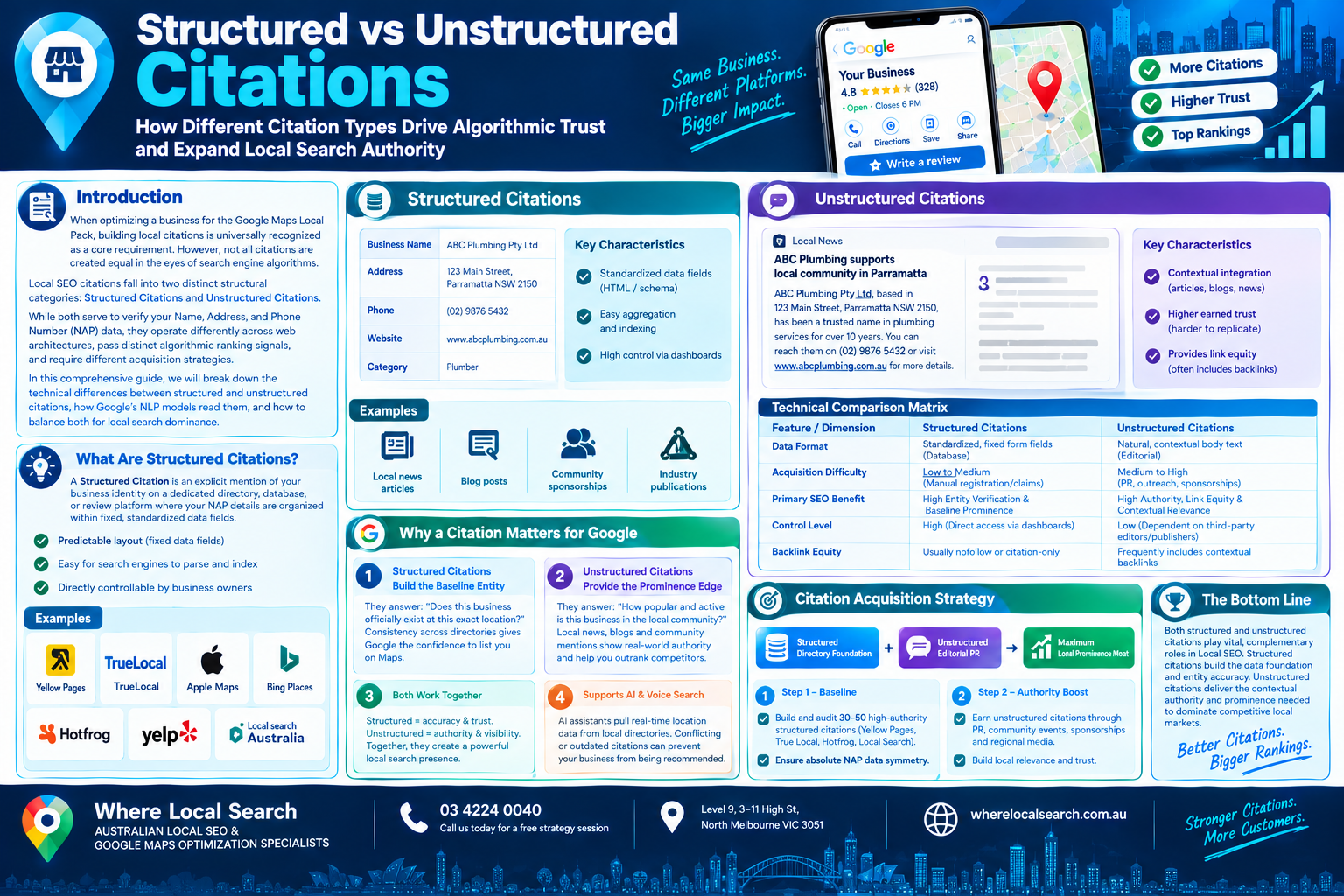
A Structured Citation is an explicit mention of your business identity on a dedicated directory, database, or review platform where your NAP details are organized within fixed, standardized data fields.
Because these platforms use dedicated form fields for Business Name, Street Address, City, Postal Code, and Phone Number, search engine crawlers can instantly parse and index the information without contextual ambiguity.
- Predictable Layout: Data is organized in structured HTML fields or schema blocks.
- Ease of Aggregation: Designed specifically for database indexing and location mapping.
- Controllable: Business owners can directly claim, edit, and update the information via profile dashboards.
- Examples: Yellow Pages Australia, True Local, Apple Maps, Bing Places, Hotfrog, Yelp, and Local Search Australia.
What Are Unstructured Citations?
An Unstructured Citation is an informal mention of your business details embedded naturally within contextual body text on general web pages, blogs, news articles, or social media platforms.
Unlike structured directories, unstructured citations do not feature dedicated form fields for NAP data. Instead, search engines utilize Natural Language Processing (NLP) to read the surrounding text, recognize your brand name, and connect it to a physical location or phone number.
- Contextual Integration: Details appear within articles, press releases, blog posts, or editorial reviews.
- Higher Earned Trust: Difficult to acquire and replicate, giving them high algorithmic authority.
- SEO Link Equity: Frequently accompanied by contextual dofollow or nofollow backlinks to your domain.
- Examples: A feature article in a local newspaper, a blog post about top local service providers, a sponsorship mention on a community sports club website, or a guest quote on an industry portal.
Technical Comparison Matrix
| Feature / Dimension | Structured Citations | Unstructured Citations |
|---|---|---|
| Data Format | Standardized, fixed form fields (Database) | Natural, contextual body text (Editorial) |
| Acquisition Difficulty | Low to Medium (Manual registration/claims) | Medium to High (PR, outreach, sponsorships) |
| Primary SEO Benefit | High Entity Verification & Baseline Prominence | High Authority, Link Equity & Contextual Relevance |
| Control Level | High (Direct access via user dashboards) | Low (Dependent on third-party editors/publishers) |
| Backlink Equity | Usually nofollow or citation-only | Frequently includes contextual backlinks |
How Google Evaluates Both Citation Types
Google’s local search algorithm uses both citation formats in tandem to build a complete trust profile for your business:
1. Structured Citations Establish the "Baseline Entity"
Structured citations answer the fundamental question: "Does this business officially exist at this exact location?" Having identical NAP data cross-referenced across dozens of structured directories provides search engines with the baseline confidence needed to list your business on Google Maps.
2. Unstructured Citations Provide the "Prominence Edge"
Unstructured citations answer the competitive question: "How popular, authoritative, and active is this business within its local community?" Because anyone can create a free directory listing, structured citations alone rarely guarantee a #1 ranking in competitive markets. Unstructured mentions from local news outlets, blogs, and community portals signal true real-world prominence, allowing your profile to outrank competitors with similar directory counts.
Citation Acquisition Strategy Matrix
Build and audit 30 to 50 high-authority Structured Citations across core national Australian directories (Yellow Pages, True Local, Hotfrog, Local Search) to establish absolute NAP data symmetry.
Earn Unstructured Citations through hyper-local PR, community event sponsorships, local charity partnerships, and features in regional industry publications.
Conclusion
Both structured and unstructured citations play vital, complementary roles in Local SEO. While structured citations build the necessary data foundation and entity accuracy search engines demand, unstructured citations deliver the contextual authority and prominence needed to dominate competitive local markets.
Auditing structured directory networks, fixing NAP inconsistencies, securing localized PR mentions, and tracking cross-surface entity authority requires ongoing technical focus.
If you want to build an authoritative local citation ecosystem across Australia, the team at Where Local Search is here to manage the process end-to-end. As premier specialists in Australian Local SEO and Google Maps optimization, we build tailored strategies that convert digital entity trust directly into long-term commercial growth.