
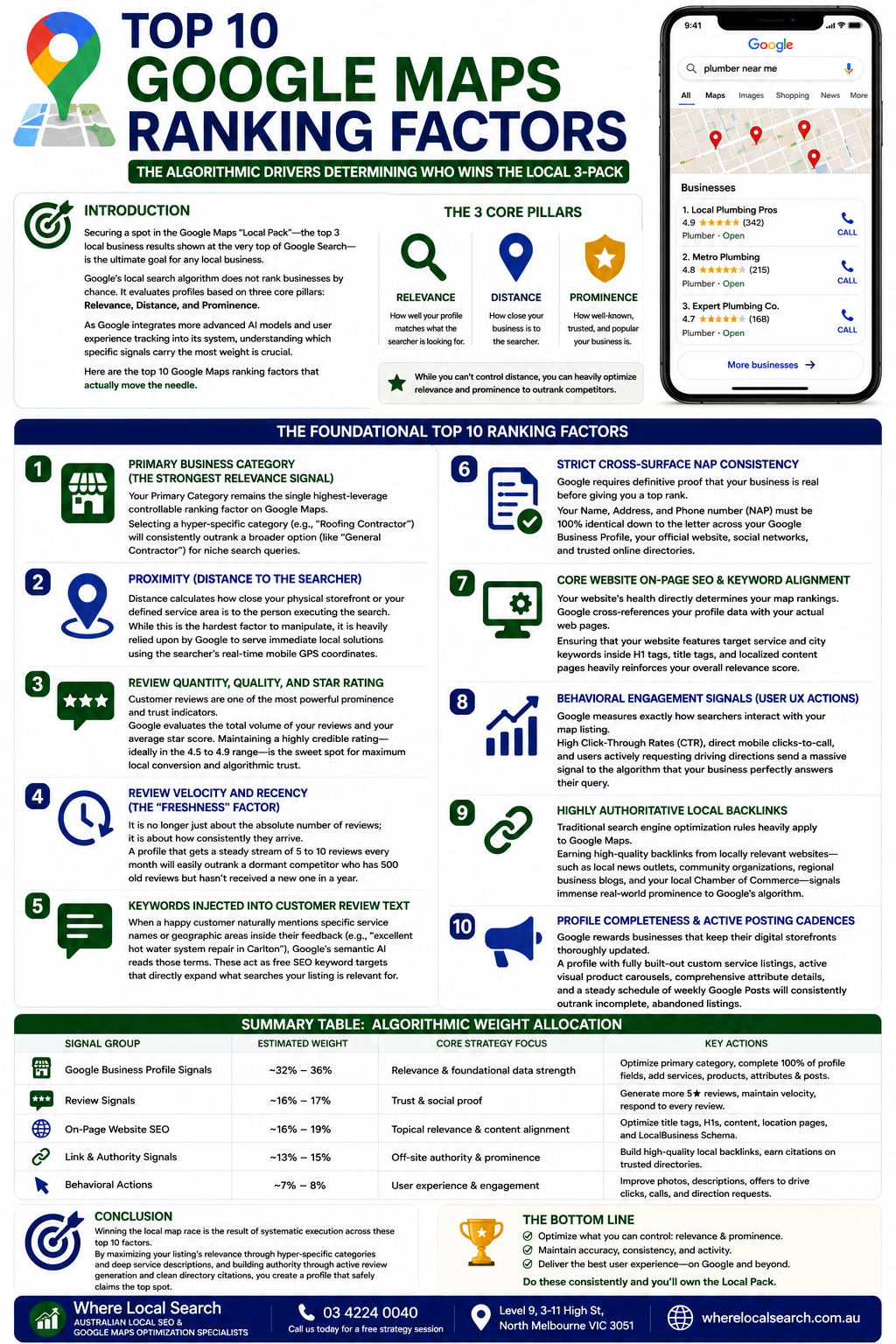
The Algorithmic Drivers Determining Who Wins the Local 3-Pack
Securing a spot in the Google Maps "Local Pack"—the top 3 local business results shown at the very top of Google Search—is the ultimate goal for any local business. It is the difference between an influx of daily phone calls and being completely invisible to motivated local buyers.
However, Google’s local search algorithm does not rank businesses by chance. It evaluates profiles based on three core pillars: Relevance, Distance, and Prominence. As Google integrates more advanced AI models and user experience tracking into its system, understanding which specific signals carry the most weight is crucial.
Based on modern Local SEO algorithm updates, here are the top 10 Google Maps ranking factors that actually move the needle.
The Foundational Top 10 Ranking Factors
1. Primary Business Category (The Strongest Relevance Signal)
Your Primary Category remains the single highest-leverage controllable ranking factor on Google Maps. It tells Google exactly what your business core identity is. Selecting a hyper-specific category (e.g., "Roofing Contractor") will consistently outrank a broader option (like "General Contractor") for niche search queries.
2. Proximity (Distance to the Searcher)
Distance calculates how close your physical storefront or your defined service area is to the person executing the search. While this is the hardest factor to manipulate, it is heavily relied upon by Google to serve immediate local solutions (like "café near me") using the searcher's real-time mobile GPS coordinates.
3. Review Quantity, Quality, and Star Rating
Customer reviews are one of the most powerful prominence and trust indicators. Google evaluates the total volume of your reviews and your average star score. Maintaining a highly credible rating—ideally in the 4.5 to 4.9 range—is the sweet spot for maximum local conversion and algorithmic trust.
4. Review Velocity and Recency (The "Freshness" Factor)
It is no longer just about the absolute number of reviews; it is about how consistently they arrive. A profile that gets a steady stream of 5 to 10 reviews every single month will easily outrank a dormant competitor who has 500 old reviews but hasn't received a new one in a year. Continuous review velocity tells Google your service remains popular and stable.
5. Keywords Injected Into Customer Review Text
When a happy customer naturally mentions specific service names or geographic areas inside their feedback (e.g., "excellent hot water system repair in Carlton"), Google's semantic AI reads those terms. These act as free SEO keyword targets that directly expand what searches your listing is highly relevant for.
6. Strict Cross-Surface NAP Consistency
Google requires definitive proof that your business is real before giving you a top rank. Your Name, Address, and Phone number (NAP) must be 100% identical down to the letter across your Google Business Profile, your official website, social networks, and trusted online directories. Data mismatches dilute your entity clarity and damage your authority.
7. Core Website On-Page SEO & Keyword Alignment
Your website’s health directly determines your map rankings. Google cross-references your profile data with your actual web pages. Ensuring that your website features target service and city keywords inside H1 tags, title tags, and localized content pages heavily reinforces your overall relevance score.
8. Behavioral Engagement Signals (User UX Actions)
Google measures exactly how searchers interact with your map listing. High Click-Through Rates (CTR), direct mobile clicks-to-call, and users actively requesting driving directions send a massive signal to the algorithm that your business perfectly answers their query.
9. Highly Authoritative Local Backlinks
Traditional search engine optimization rules heavily apply to Google Maps. Earning high-quality backlinks from locally relevant websites—such as local news outlets, community organizations, regional business blogs, and your local Chamber of Commerce—signals immense real-world prominence to Google’s algorithm.
10. Profile Completeness and Active Posting Cadences
Google rewards businesses that keep their digital storefronts thoroughly updated. A profile with fully built-out custom service listings, active visual product carousels, comprehensive attribute details, and a steady schedule of weekly Google Posts will consistently outrank incomplete, abandoned listings.
Summary Table: Algorithmic Weight Allocation
| Signal Group | Estimated Weight | Core Strategy Focus |
|---|---|---|
| Google Business Profile Signals | ~32% - 36% | Precise primary category structure & 100% profile fields completed. |
| Review Signals | ~16% - 17% | Automating active review collection to maintain constant review velocity. |
| On-Page Website SEO | ~16% - 19% | Aligning website text with GBP keywords & deploying LocalBusiness Schema. |
| Link & Authority Signals | ~13% - 15% | Building citations and backlinks from high-value local news or commerce sites. |
| Behavioral Actions | ~7% - 8% | Optimizing photos and carousels to drive clicks, calls, and direction actions. |
Conclusion
Winning the local map race is the result of systematic execution across these top 10 factors. By maximizing your listing's relevance through hyper-specific categories and deep service descriptions, and building authority through active review generation and clean directory citations, you create a profile that safely claims the top spot.
Managing continuous geo-targeted keyword shifts, tracking review trends, building high-authority local links, and maintaining cross-surface directory data can become an overwhelming technical burden beside managing day-to-day storefront operations.
If you want to ensure your business hits every major algorithmic indicator to secure your place in the Google Maps Local Pack across Australia, the team at Where Local Search is here to deliver. As dedicated specialists in Australian Local SEO and Google Maps optimization, we systematically scale your prominence signals to convert map search impressions directly into long-term commercial growth.