
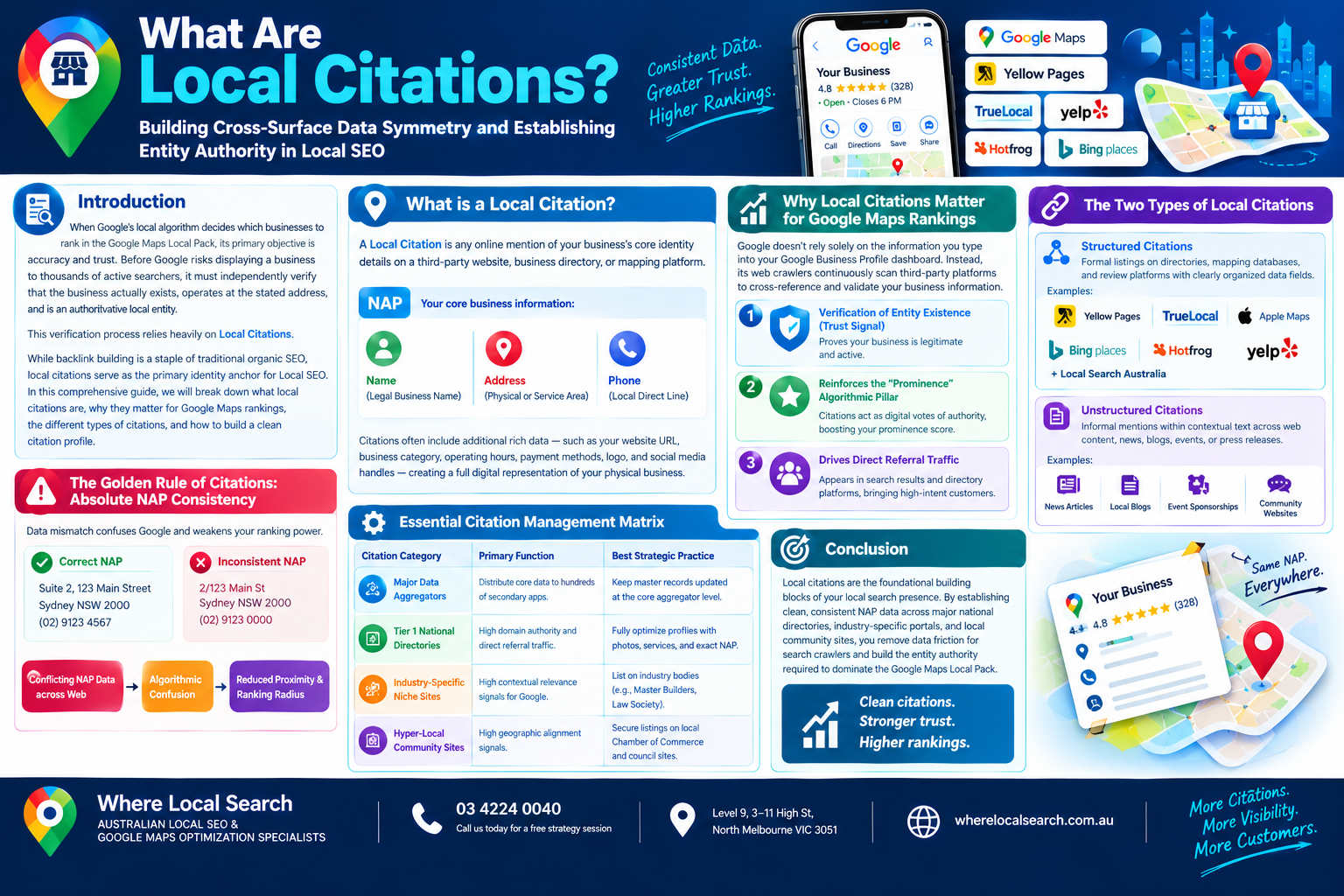
Building Cross-Surface Data Symmetry and Establishing Entity Authority in Local SEO
When Google’s local algorithm decides which businesses to rank in the Google Maps Local Pack, its primary objective is accuracy and trust. Before Google risks displaying a business to thousands of active searchers, it must independently verify that the business actually exists, operates at the stated address, and is an authoritative local entity.
This verification process relies heavily on Local Citations.
While backlink building is a staple of traditional organic SEO, local citations serve as the primary identity anchor for Local SEO. In this comprehensive guide, we will break down what local citations are, why they matter for Google Maps rankings, the different types of citations, and how to build a clean citation profile.
What is a Local Citation?
A Local Citation is any online mention of your business's core identity details on a third-party website, business directory, or mapping platform.
At its core, a citation revolves around your NAP data:
📌 Name: Legal Business Name
📌 Address: Physical Storefront or Registered Service Area
📌 Phone Number: Local Direct Line
Citations often include additional rich data—such as your website URL, business category, operating hours, payment methods, logo, and social media handles—creating a full digital representation of your physical business.
Why Local Citations Matter for Google Maps Rankings
Google doesn't rely solely on the information you type into your Google Business Profile dashboard. Instead, its web crawlers continuously scan third-party platforms to cross-reference and validate your business information:
If a business is listed on Google Maps but has zero mentions across other reputable national directories, Google treats it with suspicion. Having consistent NAP data listed on well-established platforms (like Yellow Pages, True Local, or Hotfrog) proves to Google that your business is legitimate and active.
Google calculates local rankings based on Distance, Relevance, and Prominence. Citations act as digital votes of authority. The more high-quality, geographically relevant directories that reference your exact business details, the higher your overall prominence score becomes.
Primary local directories rank prominently in standard Google search results for localized service queries (e.g., "electricians in Sydney"). Maintaining complete, attractive profiles on these directory platforms allows you to capture high-intent referral traffic directly from consumers browsing those directories.
The Two Types of Local Citations
These are formal listings on structured online business directories, mapping databases, and review platforms where your NAP data is clearly organized in fixed data fields.
Examples: Yellow Pages Australia, True Local, Apple Maps, Bing Places, Hotfrog, Yelp, and Local Search Australia.
These are informal mentions of your business details within contextual text across general web content, such as news articles, local blog posts, event sponsorships, or press releases.
Examples: A feature in a local newspaper covering your business opening, a mention on a local sports club’s sponsor page, or a review on a community blog.
The Golden Rule of Citations: Absolute NAP Consistency
The single biggest mistake local businesses make with citations is data mismatch. If your Google Business Profile lists your address as "Suite 2, 123 Main Street", but your True Local listing says "2/123 Main St", or your Yellow Pages features an outdated phone number from three years ago, Google gets conflicting data.
Data discrepancies weaken Google’s confidence in your entity information. When search engines encounter conflicting NAP details, they protect user experience by lowering your profile's ranking radius on Google Maps.
Essential Citation Management Matrix
| Citation Category | Primary Function | Best Strategic Practice |
|---|---|---|
| Major Data Aggregators | Distribute core data to hundreds of secondary apps. | Keep master records updated at the core aggregator level. |
| Tier 1 National Directories | High domain authority and direct referral traffic. | Fully optimize profiles with photos, services, and exact NAP. |
| Industry-Specific Niche Sites | High contextual relevance signals for Google. | List on industry bodies (e.g., Master Builders, Law Society). |
| Hyper-Local Community Sites | High geographic alignment signals. | Secure listings on local Chamber of Commerce and council sites. |
Conclusion
Local citations are the foundational building blocks of your local search presence. By establishing clean, consistent NAP data across major national directories, industry-specific portals, and local community sites, you remove data friction for search crawlers and build the entity authority required to dominate the Google Maps Local Pack.
Auditing historical directory duplicates, fixing broken NAP variations across hundreds of platforms, submitting to data aggregators, and maintaining cross-surface data symmetry requires meticulous technical execution.
If you want to clean up your web citations and build an authoritative Local SEO foundation across Australia, the team at Where Local Search is here to manage the process end-to-end. As leading specialists in Local SEO and Google Maps optimization, we build structured systems that turn digital trust directly into long-term commercial growth.