
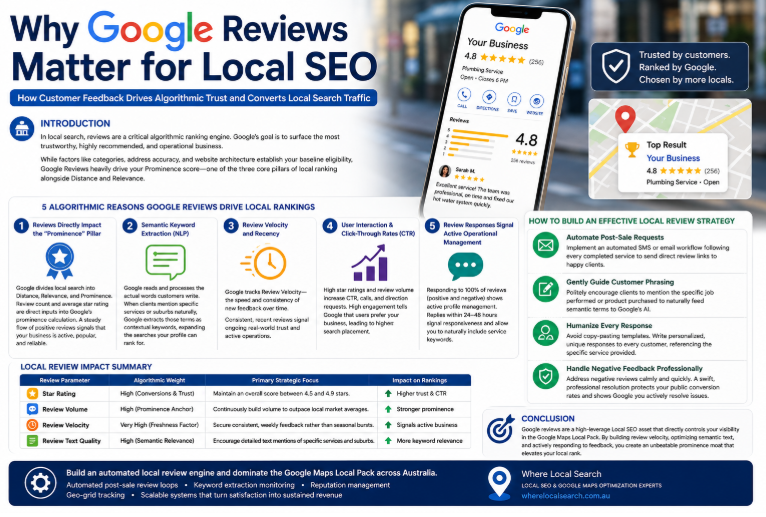
How Customer Feedback Drives Algorithmic Trust and Converts Local Search Traffic
In the world of local search, customer reviews are no longer just social proof or star ratings—they are a critical algorithmic ranking engine. When potential buyers search for a service near them, Google’s primary goal is to surface the most trustworthy, highly recommended, and operational business available.
While factors like categories, address accuracy, and website architecture establish your baseline eligibility, Google Reviews heavily drive your Prominence score—one of the three core pillars of local ranking alongside Distance and Relevance.
In this comprehensive guide, we will break down the exact technical reasons why Google reviews matter for Local SEO, how the algorithm reads customer feedback, and how to build a scalable review acquisition strategy.
5 Algorithmic Reasons Google Reviews Drive Local Rankings
1. Reviews Directly Impact the "Prominence" Pillar
Google officially divides local search factors into Distance, Relevance, and Prominence. Prominence measures how well-known, reputable, and trusted a business is across the web.
💡 The Algorithmic Value: Review count and average star rating are direct inputs into Google’s prominence calculation. A profile with a consistent flow of positive feedback signals to the algorithm that the business is active, popular, and reliable, allowing it to beat out closer competitors.
2. Semantic Keyword Extraction (Natural Language Processing)
Google utilizes advanced Natural Language Processing (NLP) models to read and process the actual words customers write in their reviews.
💡 The Algorithmic Value: When satisfied clients mention specific services or suburb names naturally in their text (e.g., "Best emergency plumbing service in Carlton"), Google extracts those terms. These act as contextual SEO keywords that expand the exact search terms your profile can rank for in the Local Pack.
3. Review Velocity and Recency (The Freshness Factor)
It is a major misconception that having 100 historical reviews is enough. Google tracks Review Velocity—the speed and consistency at which new feedback arrives over time.
💡 The Algorithmic Value: A dormant listing that received 100 reviews two years ago but zero in the last six months signals declining operations. Conversely, a profile gaining 5 to 10 fresh reviews every single month demonstrates ongoing real-world consumer trust.
4. User Interaction & Click-Through Rates (CTR)
Customer reviews serve as a major behavioral trust barrier. Google tracks how human searchers interact with your map pin.
💡 The Algorithmic Value: High star ratings (ideally between 4.5 and 4.9) combined with high review volume dramatically increase your Click-Through Rate (CTR), direct mobile phone calls, and driving direction requests. High user engagement metrics tell Google that users prefer your storefront, leading to higher search placement.
5. Review Responses Signal Active Operational Management
How you engage with your reviews is just as important as receiving them.
💡 The Algorithmic Value: Responding to 100% of your reviews—both positive and negative—demonstrates active profile maintenance. Replying to reviews within 24 to 48 hours signals operational responsiveness, while allowing you to naturally integrate secondary service keywords into your replies.
How to Build an Effective Local Review Strategy
To maximize the SEO value of your Google reviews, implement this actionable framework:
Do not leave review collection to chance. Implement an automated SMS or email workflow following every completed service to send direct review links to happy clients.
When requesting feedback, politely encourage clients to mention the specific job performed or product purchased to naturally feed semantic terms to Google's AI.
Avoid copy-pasting automated template replies. Write personalized, unique responses to every customer, thanking them and referencing the specific service provided.
Address negative reviews calmly and quickly. A swift, professional resolution protects your public conversion rates and shows Google you actively resolve customer issues.
Local Review Impact Summary
| Review Parameter | Algorithmic Weight | Primary Strategic Focus |
|---|---|---|
| Star Rating | High (Conversions & Trust) | Maintain an overall score between 4.5 and 4.9 stars. |
| Review Volume | High (Prominence Anchor) | Continuously build volume to outpace local market averages. |
| Review Velocity | Very High (Freshness Factor) | Secure consistent, weekly feedback rather than seasonal bursts. |
| Review Text Quality | High (Semantic Relevance) | Encourage detailed text mentions of specific services and suburbs. |
Conclusion
Google reviews are much more than public testimonials—they are a high-leverage Local SEO asset that directly controls your visibility in the Google Maps Local Pack. By building a steady review velocity, optimizing semantic text depth, and actively responding to feedback, you establish an unbeatable prominence moat that elevates your local rank.
Setting up automated post-sale review loops, monitoring keyword extractions across feedback, managing reputation responses, and tracking geo-grid movements requires continuous operational and technical execution.
If you want to build an automated local review engine and dominate the Google Maps Local Pack across Australia, the expert team at Where Local Search is here to guide your strategy. As premier specialists in Local SEO and Google Maps optimization, we build comprehensive, data-driven systems that securely turn customer satisfaction into sustained commercial revenue.